


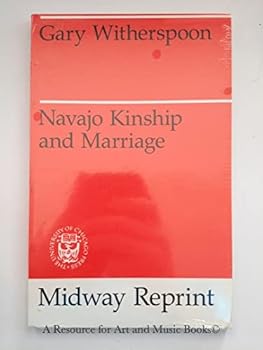
Navajo Kinship and Marriage

Select Format
Select Condition 
Book Overview
The Navajo are one of the most studied people in the world; yet their social organization is one of the least well understood. In Navajo Kinship and Marriage, Gary Witherspoon, a fluent speaker of the Navajo language who lived among the Navajo for eight years, offers a new theoretical approach to kinship based on its cultural dimensions. Witherspoon makes a primary distinction between culture (patterns for behavior) and the system of social relations (observable patterns of behavior) in this definitive work on Navajo kinship and marriage. "Witherspoon . . . clarifies problems pertaining to Navajo kinship and marriage through his skillful use of the concepts of cultural and social systems. He adds to the body of knowledge on the Navajo by his own fieldwork and unique life experiences." --R. S. Freed, Sociology "Not only can Witherspoon's book on Navajo kinship help unravel the web for the Anglo willing to concentrate, it can also bring to Navajo readers an understanding of why Anglos don't understand Navajo family relationships." --Joanne Reuter, Navajo Times "This is an important work on Navajo kinship and marriage." --David F. Aberle, American Anthropology
Format:Paperback
Language:English
ISBN:0226904172
ISBN13:9780226904177
Release Date:June 1975
Publisher:University of Chicago Press
Length:145 Pages
Weight:0.50 lbs.
Dimensions:0.4" x 5.5" x 8.5"
Customer Reviews
1 rating
kinship as a symbolic system
Published by Thriftbooks.com User , 17 years ago
Like all ethnography, this is as much an illustration of the theory guiding it as it is a study of the Navajo. The theory? Witherspoon came out of Chicago under the influence of David Schneider and Clifford Geertz, and it shows. Schneider more so than Geertz. Put differently, it is not an exercise in interpretive anthropology, at least in any reflective sense. The basis of the theory is Talcott Parsons distinction between the cultural (a system of symbolic meanings) and the social (the actual relationships between people). Parsons - and the School of Social Relations at Harvard - was the common denominator between Geertz and Schneider. The book, predictably, has two parts: the first part analyzes Navajo kinship as a cultural system (meanings), the second part as a social system. Witherspoon's writing is clear, and his theoretical discussion is simple and straightforward. It is also not terribly innovative. But of course, as he stresses repeatedly in his writings, Witherspoon spent very little time in graduate school. His analysis of Navajo kinship is very Polynesian - that is, it either anticipates Schneider's discussion of the tabinau on Yap, or it reflects what Schneider was already lecturing on at Chicago a decade prior to his Critique of Kinship. The points Witherspoon makes here about the Navajo are later given fuller elaboration in his Language and Art in the Navajo Universe. The points he makes about kinship are developed more completely in Schneider's later work. In sum, if you are interested in Schneider's cultural theory, Witherspoon applies it with much greater clarity than Schneider, and if you are interested in Navajo ethnology, this is a undemanding introduction.
Copyright © 2026 Thriftbooks.com Terms of Use
| Privacy Policy | Do Not
Sell/Share My Personal Information | Cookie Policy | Cookie Preferences | Accessibility Statement
ThriftBooks® and the ThriftBooks® logo are registered trademarks of Thrift Books Global, LLC
ThriftBooks® and the ThriftBooks® logo are registered trademarks of Thrift Books Global, LLC
