


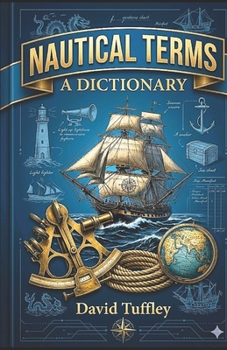
Nautical Terms: A Dictionary

The sea has its own language. Long before GPS, before engine rooms and satellite phones, before the world shrank to the size of a screen, sailors developed a vocabulary as precise and purposeful as the vessels they crewed. Every rope had a name. Every manoeuvre a term. Every condition of wind, water, tide and hull a word that could, in the right moment, mean the difference between safe passage and disaster. That language - salt-worn, centuries deep, and still very much alive - is what this book is about.
A Dictionary of Nautical Terms by David Tuffley is a comprehensive and authoritative reference guide to the language of the sea, covering the full breadth of maritime vocabulary from the age of sail to the modern era. Whether you're an experienced mariner looking to sharpen your knowledge, a newcomer to boating trying to make sense of the terminology, a writer researching a seafaring story, or simply someone who has always been curious about what people mean when they talk about "beating to windward" or "splicing the mainbrace" - this dictionary belongs within arm's reach.
Inside you'll find hundreds of carefully defined entries spanning navigation, seamanship, rigging, meteorology, vessel types, sailing manoeuvres, knots, tides, and the rich heritage of naval tradition. Entries range from the purely practical - the difference between port and starboard, the function of a bobstay, the mechanics of tacking - to the historically fascinating. Many of the phrases that have woven themselves permanently into everyday English have their origins at sea. To be "taken aback." To "toe the line." To have "the bitter end." To be "three sheets to the wind." This dictionary traces those phrases back to their nautical roots, revealing the seafaring world from which our common language quietly emerged.
The entries are written with the clarity and authority of someone who knows both the academic and the practical dimensions of maritime life. David Tuffley brings to this work the precision of a scholar and the enthusiasm of a man who genuinely loves the water - a combination that makes this dictionary not merely useful, but genuinely engaging to read. You don't need to be aboard a vessel to find yourself drawn in. The sea, as it turns out, makes for compelling reading from dry land too.
From the mechanics of a running bowline to the history of the Beaufort scale, from the meaning of "avast" to the etymology of "slush fund," every entry rewards attention. This is maritime heritage distilled into accessible, alphabetically arranged form - a book that serves equally well as a practical desk reference, a browsable companion for curious minds, and an essential resource for anyone with salt water in their veins or an interest in the ships and sailors who shaped the modern world.
The sea connects continents, defines cultures, and has driven human history for as long as there have been humans willing to push off from shore and see what lies beyond the horizon. A Dictionary of Nautical Terms is your guide to the language that made all of it possible.
Customer Reviews
ThriftBooks ® and the ThriftBooks ® logo are registered trademarks of Thrift Books Global, LLC
