


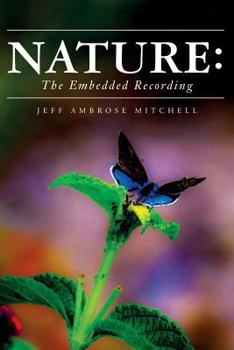
Nature: The Embedded Recording
No Customer Reviews

"The author also makes the case that all evolution is female and that all anatomy is ultimately generated from the female, a fact obscured by the misplaced focus on chromosomes. This is a remarkably rigorous and erudite study, painstakingly written over a decade. Ambrose Mitchell is refreshingly dismissive of prevailing intellectual conventions and makes a convincing argument that Jean-Baptiste Lamarck's theory of evolution is superior in certain decisive respects to Darwin's. He also explains the ways in which the reliance on a genetic interpretation of nature has been not only intellectually misguided, but also practically damaging (for example, with respect to experts' understanding of disease). And in one of the more philosophical chapters, he discusses the uniqueness of the human mind -"we are the life form with issues"-with admirable nuance and accessible lucidity. A bold and persuasive alternative to contemporary evolutionary theory." - Kirkus Reviews
Do we really understand even the most fundamental aspects of nature? The chromosomes of the male and female unite in the ovum, and then a new life begins. Yet, before the discovery of chromosomes there had already been over a century of research in to parthenogenesis, the phenomenon of the female producing offspring without any contact with a male. Parthenogenesis is now known to occur in hundreds of species of animals: insects, arachnids, crustaceans, fish, amphibians, reptiles and birds. Nature: The Embedded Recording takes a very in depth look at what we really know about nature, and what we only thought we knew. It shows that Lamarck was correct about evolution, not Darwin, and the only reason we have not seen it is because Charles Bonnet was also correct about ovulism - life comes from the female. The book explores how our accepted view of nature, the Darwinian/genetic view, was the result of nothing more than common human weaknesses: sexual insecurity, prejudice, elitism, and embitterness. The pivotal mechanism of nature is not some science fiction oriented genetic code, but a fascinating little enzyme, what Nobel Prize Laureate Professor Paul Boyer called "a splendid molecular machine". The only effect of the genes on living organisms is exactly what we have always seen: the color, length, and thickness of the organism. However, the anatomy, evolution, and instinct of living organisms is contained in that tiny rotating enzyme. Life can be best described as a recording, not a code. The foundation of life is documented metabolism in the ATPase, not chemical reaction in the genes.
Do we really understand even the most fundamental aspects of nature? The chromosomes of the male and female unite in the ovum, and then a new life begins. Yet, before the discovery of chromosomes there had already been over a century of research in to parthenogenesis, the phenomenon of the female producing offspring without any contact with a male. Parthenogenesis is now known to occur in hundreds of species of animals: insects, arachnids, crustaceans, fish, amphibians, reptiles and birds. Nature: The Embedded Recording takes a very in depth look at what we really know about nature, and what we only thought we knew. It shows that Lamarck was correct about evolution, not Darwin, and the only reason we have not seen it is because Charles Bonnet was also correct about ovulism - life comes from the female. The book explores how our accepted view of nature, the Darwinian/genetic view, was the result of nothing more than common human weaknesses: sexual insecurity, prejudice, elitism, and embitterness. The pivotal mechanism of nature is not some science fiction oriented genetic code, but a fascinating little enzyme, what Nobel Prize Laureate Professor Paul Boyer called "a splendid molecular machine". The only effect of the genes on living organisms is exactly what we have always seen: the color, length, and thickness of the organism. However, the anatomy, evolution, and instinct of living organisms is contained in that tiny rotating enzyme. Life can be best described as a recording, not a code. The foundation of life is documented metabolism in the ATPase, not chemical reaction in the genes.
Format:Paperback
Language:English
ISBN:1548592676
ISBN13:9781548592677
Release Date:July 2017
Publisher:Createspace Independent Publishing Platform
Length:386 Pages
Weight:1.13 lbs.
Dimensions:0.8" x 6.0" x 9.0"
Related Subjects
NatureCustomer Reviews
0 rating
Copyright © 2026 Thriftbooks.com
Terms of Use | Privacy Policy | Do Not Sell/Share My Personal Information | Cookie Notice | Cookie Preferences | Accessibility Statement
ThriftBooks ® and the ThriftBooks ® logo are registered trademarks of Thrift Books Global, LLC
ThriftBooks ® and the ThriftBooks ® logo are registered trademarks of Thrift Books Global, LLC
