


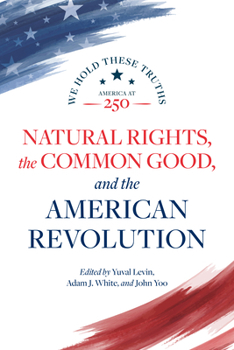
Natural Rights, the Common Good, and the American Revolution

Select Format
Select Condition 
Book Overview
This vital collection of original essays marks the 250th anniversary of American independence, as leading legal scholars and political scientists, including Robert P. George, Charles R. Kesler, Michael Zuckert, Daniel E. Burns, and Janice Rogers Brown, revisit the Declaration's "unalienable rights," the Constitution, and the founding debates over natural rights, revealing how the American Revolution balanced individual liberty against communal responsibility and what that means for democracy and civil society today.
Featuring original essays by Robert P. George, Charles R. Kesler, Michael Zuckert, Daniel E. Burns, and Janice Rogers Brown.
The year 2026 marks the 250th anniversary
of American independence, yet the founding is controversial now in ways it has
not been in decades.
The American Enterprise Institute offers a major
intellectual and educational project to reintroduce Americans to the unique
value of their national inheritance. In the fourth volume of this series, legal
scholars and political scientists examine the many ways in which the founding
generation understood the "unalienable rights" immortalized by the Declaration
of Independence.
Although the Declaration described the right to life, liberty,
and the pursuit of happiness as a "self-evident" truth, this characterization
belied the Revolutionary era's complex discourse on the origins of political
rights and their role in sustaining a political community.
Delving into these debates reveals how the
American Revolution encoded a productive tension between individual rights and
communal responsibilities at the nation's founding.
Customer Reviews
ThriftBooks ® and the ThriftBooks ® logo are registered trademarks of Thrift Books Global, LLC
