


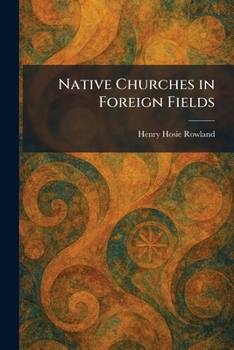
Native Churches in Foreign Fields

"Native Churches in Foreign Fields" explores the complex relationship between foreign missionary efforts and the establishment of self-governing, self-supporting local churches. Henry Hosie Rowland provides a thoughtful analysis of the transition from mission-led congregations to independent religious institutions within their own cultural contexts.
The work addresses the challenges of leadership, cultural adaptation, and the ultimate goal of creating sustainable Christian communities that are truly indigenous to their regions. Written during a pivotal era in global mission history, the book reflects on the strategies and philosophical underpinnings required to foster authentic religious growth abroad. It serves as an important historical resource for those interested in missiology, the history of Christianity, and the evolution of global church structures.
By examining the practical and theological hurdles of the early 20th century, Rowland offers insights into the vision of a global church that respects and integrates local identity while maintaining core tenets of the faith. This study is an essential read for scholars and readers interested in the development of the church beyond Western borders.
This work has been selected by scholars as being culturally important, and is part of the knowledge base of civilization as we know it. This work was reproduced from the original artifact, and remains as true to the original work as possible. Therefore, you may see the original copyright references, library stamps (as most of these works have been housed in our most important libraries around the world), and other notations in the work.
This work is in the public domain in the United States of America, and possibly other nations. Within the United States, you may freely copy and distribute this work, as no entity (individual or corporate) has a copyright on the body of the work.
As a reproduction of a historical artifact, this work may contain missing or blurred pages, poor pictures, errant marks, etc. Scholars believe, and we concur, that this work is important enough to be preserved, reproduced, and made generally available to the public. We appreciate your support of the preservation process, and thank you for being an important part of keeping this knowledge alive and relevant.
Customer Reviews
ThriftBooks ® and the ThriftBooks ® logo are registered trademarks of Thrift Books Global, LLC
