


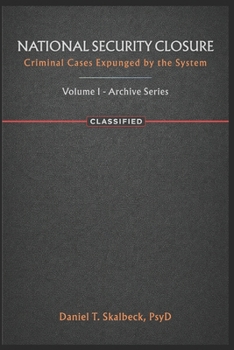
National Security Closure: Criminal Cases Expunged by the System

This book does not present mysteries to be solved.
It documents cases that were processed, categorized, and closed-often without resolution, sometimes without acknowledgment.
Drawing on frameworks from clinical psychology, behavioral analysis, and operational field experience, this work examines a series of cases whose defining characteristic is not what occurred, but how they were handled. Through structured case review and cross-case comparison, the book explores patterns that emerge when incidents are examined collectively rather than in isolation.
Written by a psychologist with experience alongside elite special forces and within federal behavioral analysis, the analysis focuses on the intersection between human behavior and institutional procedure. Particular attention is given to the mechanisms of closure: how investigations end, how narratives are stabilized, and how unresolved elements are administratively absorbed rather than resolved.
Customer Reviews
ThriftBooks ® and the ThriftBooks ® logo are registered trademarks of Thrift Books Global, LLC
