


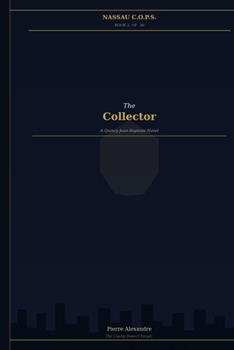
NASSAU C.O.P.S.: THE COLLECTOR

She didn't take Amelia. Amelia went with her.
At 3:09 on a Tuesday afternoon, seven-year-old Amelia Torres walks out of Roosevelt Elementary School in Freeport and takes the hand of a woman who has positioned herself relative to every camera with deliberate, practiced care. The woman is dressed professionally. She moves without urgency. She has been here before - three times in the last sixteen days - and she has timed the afternoon dismissal schedule down to the minute, watching and confirming what she already decided weeks ago.
But none of that is what stops Officer Quincy Jean-Baptiste's breath when he watches the footage. What stops him is the smile. Not a polite smile. Not the tentative brightness of a child being cautious around a stranger. The specific, comfortable, forward-leaning smile of a little girl who has been looking forward to seeing this person. Amelia Torres doesn't hesitate. She doesn't look back. She takes the woman's hand and walks out the maintenance exit, and the camera loses her at 3:09pm. Forty-four minutes ago.
The Collector has done this before. Seven children. Four states. Six years. New York, New Jersey, Connecticut, Pennsylvania. Every child was returned alive following ransom payment. Every prior investigation came apart on procedural grounds, or went quiet after the family paid, or ran into the specific wall that a sophisticated operator builds when she has someone adjacent to law enforcement watching the temperature of the case in real time. She has never been arrested. She has never been publicly identified. The federal file on her is thinner than it should be for six years of active cases - and Quincy knows that a file that thin is either incompetence or management. He is not going to assume incompetence.
He is twenty years old. Ten months on the job. He just made detective third grade after closing the Freeport Marina case - six bodies, sixty-two million in missing cash, a conviction on every count. The Torres case is his first assignment in the detective bullpen, and it is the most complex investigation Nassau County has seen in years. The woman who built it has a $350,000 ransom demand, a seventy-two-hour deadline, and the stated confidence that she will know if law enforcement escalates beyond her tolerance. That is not a threat. It is a capability assessment. She has been right every time before.
Detective Lieutenant Simone Reyes has been tracking The Collector's pattern for two years. She has research beyond anything in the federal file - a private thread connecting cases that investigators in four states have never formally linked. What develops between her and Quincy over the next seventy-two hours is a partnership built on compressed urgency, and the specific current that runs between two people who are using every available unit of focus on finding a missing child and still cannot make the other thing disappear entirely.
Amelia Torres drew Quincy a map from memory - her neighborhood, her school, the marina - with a policeman standing at the center of everything. She trusts the person who took her. She trusts, too, that someone is coming for her.
The clock is already running. Seventy-two hours. One little girl. And a detective who reads the shape of what is missing from a federal file the way most people read the words that are on the page.
NASSAU C.O.P.S.: THE COLLECTOR is Book 2 in the thirty-novel series following Quincy Jean-Baptiste from rookie officer to seasoned detective across a full career built in Nassau County, New York. Each book closes one case. Every case leaves a mark. The series is rooted in the specific geography, institutional complexity, and community texture of Long Island crime fiction - written at its most precise.
Next in the series - Book 3: THE SURGEON. Soon.
Customer Reviews
ThriftBooks ® and the ThriftBooks ® logo are registered trademarks of Thrift Books Global, LLC
