


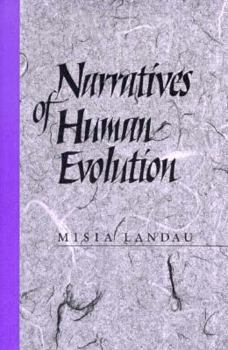
Narratives of Human Evolution


Select Format
Select Condition 
Book Overview
In the notoriously controversial field of paleoanthropology Misia Landau has found a hidden level of agreement among theories of human evolution. According to Landau, these theories are versions of... This description may be from another edition of this product.
Format:Hardcover
Language:English
ISBN:0300049404
ISBN13:9780300049404
Release Date:March 1991
Publisher:Yale University Press
Length:216 Pages
Weight:0.90 lbs.
Dimensions:8.8" x 1.0" x 6.0"
Customer Reviews
2 ratings
Merging of science and humanities
Published by Thriftbooks.com User , 23 years ago
Landau's book is a breakthrough in the studies of early humanity. Most researchers, particularly field workers, naturally assumed they were simply finding, indexing and describing bones and artifacts. Landau's innovative ideas illustrate that once the "museum pieces" are listed and described, the urge to place them in a greater context is inescapable. We are too concerned with our origins to permit our origins to be relegated to a museum directory. In order to explain and understand our ancestors, we fall back on the narrative format to explain our origins. Since our most familiar narrative experience is the "folk myth," with its frank order of events, explaining our past tends to use this easily understood framework. While she applies this formula to paleoanthropology, she argues that it fits well in the physical sciences also. Whether physical sciences or human evolution, the narrative format is given as much weight as the physical evidence.She uses a classic analysis, Valdimir Propp's 1928 work Morphology of the Folktale as her reference point. Propp used "functions" in describing the elements of a story, beginning with the hero setting on a quest, accepting a "donor's" help and undergoing tests until "arriving at a higher state" at the conclusion. Given that Propp offered 31 different functions that could be applied, there's much room for flexibility in applying the story equation in various sciences. For paleoanthropology, Landau selects nine of Propp's elements in portraying how various theorists used a similar format in describing the path of human evolution. Although Landau opens the book with the views of Thomas Henry Huxley and Ernst Haekel, the significant protagonists are the British and American thinkers, Keith, Wood, Elliot Smith, Osborn and Gregory. The central issue was whether humans became bipedal before developing large brains, or the reverse. Elliot Smith stood almost alone in viewing intelligence preceding upright walking. She provides us with a diagram summarizing these theorists before examining their individual views in the text.Landau finds use of the narrative formula as a liberating mechanism in studying our past. Those paleoanthropologists who resist adopting this technique are unnecessarily restraining themselves, she argues. Attempts by the "post-modernists" and "deconstructionists" to subvert the established narrative structure are unlikely to succeed, particularly where it is utilized in the sciences. She offers the "biography" of a subatomic particle to demonstrate how pervasive the narrative form is within scientific literature. In one sense, Landau may have provided a major step in the unity of science and humanity so earnestly sanctioned by Edward O. Wilson in his "Consilience: The Unity of Knowledge. Landau's book is a fine read and something to have as background when dealing with creating or reading science writing.
must read- anthropology, history of science, story-telling
Published by Thriftbooks.com User , 27 years ago
Yale bioanthropologist Misia Landau's groundbreaking book is a must read for anyone interested in anthropology, story-telling and history of science. This well written and scholarly researched volume reveals how all major theories of evolution unconsciously retell versions ofthe classic hero folk tale. This book is often misunderstood and misused by Creationists who attempt to dismiss the scientific basis for evolution.
Copyright © 2026 Thriftbooks.com Terms of Use
| Privacy Policy | Do Not
Sell/Share My Personal Information | Cookie Policy | Cookie Preferences | Accessibility Statement
ThriftBooks® and the ThriftBooks® logo are registered trademarks of Thrift Books Global, LLC
ThriftBooks® and the ThriftBooks® logo are registered trademarks of Thrift Books Global, LLC
