


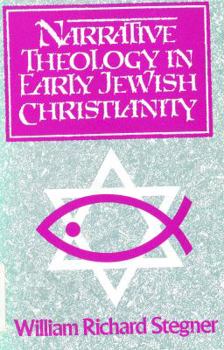
Narrative Theology in Early Jewish Christianity

Narrative Theology in Early Jewish Christianity This description may be from another edition of this product.
Format:Paperback
Language:English
ISBN:0804202656
ISBN13:9780804202657
Release Date:January 1989
Publisher:John Knox Pr
Length:141 Pages
Weight:0.46 lbs.
Customer Reviews
1 rating
The play's the thing...
Published by Thriftbooks.com User , 22 years ago
Narrative theology is perhaps my favourite type of theology. While I have an affinity for the philosophical and systematic theological enterprise, I still find the greater pull comes from more narrative story forms. This has a long history in religious tradition, Jewish, Christian and otherwise. The Greek and Roman myths are narrative theologies of their tradition that are about all that remains of their religion in popular consciousness. Other religions did likewise with their popular cults. Aesop's fables and the storytelling traditions to the present time (highlighted by the work of people such as Joseph Campbell, among others) show that narrative power transcends the religious and spills into our everyday need for stories.Jesus used narrative theological devices when he taught using parables. The Hebrew scriptures are built upon narratives -- from the story of creation to the stories given by the prophets post-exile, the theology of ancient Israel was likewise built upon narratives. The power of storytelling was well-known and well-appreciated by them.Stegner, in this text, explores four primary stories for early Christianity: the baptism of Jesus, the temptation of Jesus, the feeding of the five thousand, and the transfiguration. These stories were part of the formative basis of Christian belief before Judaism and Christianity were discreet traditions. Stegner looks at these four narratives, therefore, in the context of the first-century Jewish community. Stegner follows a basic pattern for each story: identification of the primary issues; looking at the words from the Bible (the Hebrew Bible, the Septuagint, widely used by both Jews and Christians, as well as New Testament passages); what the Jewish tradition was around these texts and issues; the work of the Jewish Christians of the time; and finally, theological significance of the stories. However, for the first story (the baptism of Jesus), Stegner also relates the story to the binding of Isaac, as a primary formative story for community and covenant.This approach is actually derivative of Birger Gerhardsson's three-fold method of analysing stories in terms of Bible, Jewish tradition, and Jewish-Christian presence in the stories. (Gerhardsson's influence is explained in the introduction to the text, which also gives a broader overview of what narrative theology is and its significance for biblical and theological analysis today). This is not narrative criticism, a different biblical tool, although some of the analysis contained in the text may use narrative criticism devices.This book helps readers recover some of the Jewish aspects of Jesus (and consequently, of the Christian tradition), illustrating how close the traditions are in many respects. It also highlights the importance of storytelling to both traditions. The book is valuable to scholars and to general audiences interested in the development of gospel stories, images of Jesus in the Bible, and those looking
Copyright © 2026 Thriftbooks.com Terms of Use
| Privacy Policy | Do Not
Sell/Share My Personal Information | Cookie Policy | Cookie Preferences | Accessibility Statement
ThriftBooks® and the ThriftBooks® logo are registered trademarks of Thrift Books Global, LLC
ThriftBooks® and the ThriftBooks® logo are registered trademarks of Thrift Books Global, LLC
