
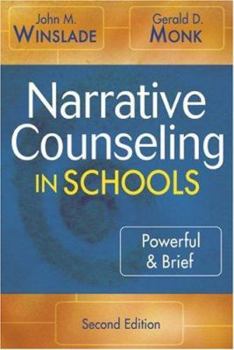
Written specifically for those working in educational settings. Packed with intriguing clinical vignettes and one of the best step-by-step′ guides to practice available. Because it is written with such elegant simplicity, it could be just as useful to senior practitioners as to those in training." David Epston, Family Therapist, The Family Therapy Center, Auckland, New Zealand "Has the potential to transform the practice of school counseling. Full of case studies and using a step-by-step approach, this book should be must reading for any professional school counselor. As school counseling enters the 21st century, this book should lead the way. " Courtland C. Lee, 1997-1998 President of the American Counseling Association, Professor, Counselor Education Program, University of Virginia "This book should be in every school counselor′s library. It provides innovative ideas for handling the difficult cases-abuse, stealing, violence, truancy, academic failure and is written with microskill clarity. You will be using it constantly to help resolve your most challenging cases. " Allen E. Ivey, Distinguished Professor Emeritus, University of Massachusetts, Amherst, and President, Microtraining Associates, Inc. "Most counseling approaches select children out. This one knits them back in. All in all, the best book to hit the field of school counseling in years." Lynn Hoffman, Northampton, Massachusetts Bring the advantages of narrative therapy into your school practice. Winslade and Monk offer the theory that our stories shape our lives, that a "bad" story can be changed to a "good" story with work and patience. The authors believe that this change can make a world of difference for students who are "in trouble" at school. This new book shows how narrative counseling can be a powerful tool to use with student clients. The authors follow a specific case to illustrate how narrative therapy can work in a school setting. Then they offer you a step-by-step guide to the techniques of narrative therapy so that you can: * Listen to, hear, and understand what students are saying * Respond in ways to encourage the continuation of dialogue * Ask the kinds of questions that elicit more information * Externalize students′ problems instead of focusing "blame" * Help clients build alternative "stories" that make coping easier while they make work to make positive changes Brief examples illustrate how this type of counseling can work in different situations in your school practice. Teachers and school leaders as well as counselors can use this guide to facilitate positive interactions with students. Counselors can use narrative counseling ideas to facilitate group or one-on-one work with students, ease student-family interactions, and lighten the emotional load for the entire school population.
ThriftBooks sells millions of used books at the lowest everyday prices. We personally assess every book's quality and offer rare, out-of-print treasures. We deliver the joy of reading in recyclable packaging with free standard shipping on US orders over $20. ThriftBooks.com. Read more. Spend less.

