


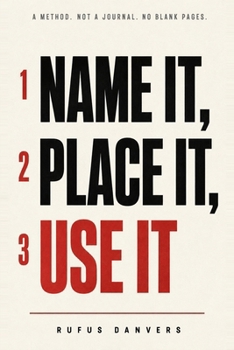
Name It, Place It, Use It

You cannot talk yourself out of a feeling. You have tried. It works about one time in nine, and the eight failures are why you are reading this.
NAME IT, PLACE IT, USE IT is a manual, not a meditation. One method, three steps, twelve worked applications - and a procedure short enough to run in the four minutes between an email arriving and a meeting starting.
THE METHOD
NAME IT - find the precise word, not the approximate one. Most adults run their entire emotional life on four words: fine, tired, stressed, busy. Dread and stress ask for completely different actions, and mislabelling one as the other is why your weekend of reorganising the task list changed nothing.
PLACE IT - where it is sitting in the body, and what specifically set it off in the last seventy-two hours. Not your childhood. Thursday.
USE IT - every feeling is asking for something, usually something small and reasonable in an unreasonable voice. Find the request. Then grant it, convert it, or refuse it out loud - and turn that into an action with a verb and a time.
THE TWELVE
Anger. Dread. Envy. Shame. Guilt. Resentment. Loneliness. Boredom. Disappointment. Impatience. Numbness. Joy.
One chapter each, all built the same way: what it actually is, the precise words available and what it is usually confused with, where it sits in the body, what it is asking for, the exact action to take - and the three ways people reliably misuse it.
ALSO INSIDE
- The whole method running in real time on one ordinary Tuesday morning
- The ninety-second version, for when you are in the room and cannot leave
- What to do when the method fails - five failure modes, and what each one is telling you
- Why nothing you decide at two in the morning should be trusted
- Three questions to ask when somebody brings you a feeling, and why advice makes it worse
- Forty actions that take under fifteen minutes
- The two-line log: ninety seconds a day, no journalling, no mood charts
WHAT IS NOT IN HERE
No studies. No statistics. No percentages, no "research shows". That is a decision, stated on page two rather than buried, and the author is not a clinician and never pretends to be. This is a procedure you can test on yourself this afternoon on something that is actually bothering you - which is a better test than any bibliography.
Customer Reviews
ThriftBooks ® and the ThriftBooks ® logo are registered trademarks of Thrift Books Global, LLC
