


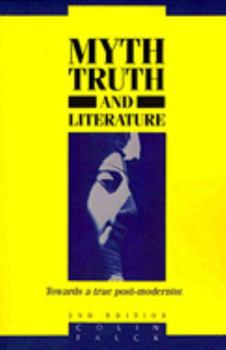
Myth, Truth, and Literature: Towards a True Post-Modernism


Select Format
Select Condition 
Book Overview
Colin Falck's book has had a widespread influence since it first appeared in 1989. Hailed as a work that alters the way we think about literary theory and its institutionalization in America and Britain, it is a philosophically informed account of the "paradigm-shift" required to replace structuralism and poststructuralism as modes of perceiving literature and related culture. Falck now supplements this second paperback edition with important new material opening up fresh horizons within the subject.
Format:Paperback
Language:English
ISBN:0521467519
ISBN13:9780521467513
Release Date:August 1994
Publisher:Cambridge University Press
Length:232 Pages
Weight:1.45 lbs.
Dimensions:0.7" x 5.4" x 8.5"
Customer Reviews
2 ratings
Deep background for literary theory...and life
Published by Thriftbooks.com User , 18 years ago
Actually, Falck's critique of postmodernism is only the first chapter. The rest of the book is a detailed survey of the rest of philosophical history (Kant, Herder, Goethe, Schiller, Schelling, Hegel, Coleridge) and its impact on literary theory, epistemology, and even ontology. It is not an easy book, but it is immensely rewarding. The appendix "Romanticism and Poetics" is especially well-done.
Falck attempts a deathblow to post-structuralist obfuscation
Published by Thriftbooks.com User , 27 years ago
I found the book invaluable for its lucid exposure of the whole pallid and incoherent post-structuralist take on language and human experience in general. Falck shows how language arises out of our nature as embodied creatures who discover our limits and powers in the context of our physical environment; what's more, the physical world itself arises in correlation to this emergent consciousness. Far from being absolute and independent of human consciousness, the physical world is in a real sense created and maintained by imagination (it's not a new idea---Coleridge and the Romantics figured it out 200 years ago). If this whole business sounds crazy, read Falck's book (and Owen Barfield's *Poetic Diction*); what sounds crazy to 20th century common sense will prove inevitable in the light of a little reasoning and reflection. Don't be put off by all the references to Kant and Wittgenstein; just read the thing straight through for the argument and the pieces will fall into place even if you don't know anything about the history of philosophy.
Copyright © 2026 Thriftbooks.com Terms of Use
| Privacy Policy | Do Not
Sell/Share My Personal Information | Cookie Policy | Cookie Preferences | Accessibility Statement
ThriftBooks® and the ThriftBooks® logo are registered trademarks of Thrift Books Global, LLC
ThriftBooks® and the ThriftBooks® logo are registered trademarks of Thrift Books Global, LLC
