
Skip to content
Scan a barcode
Scan
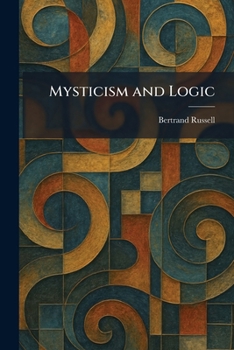
Hardcover Mysticism and Logic Book

ISBN: 1025465768

ISBN13: 9781025465760

Mysticism and Logic

Select Format

Select Condition ThriftBooks Help Icon

Recommended

Format: Hardcover

Condition: New

$32.95
Ships within 2-3 days
Save to List

Book Overview

"Mysticism and Logic" is a seminal collection of essays by Bertrand Russell that explores the fundamental tension between intuitive, mystical insights and the rigorous demands of logical analysis. Throughout this work, Russell navigates the boundaries between science and philosophy, advocating for a rationalistic approach to understanding the universe while acknowledging the historical and psychological significance of mystical thought. The volume includes some of Russell's most influential writings, such as the title essay and "On Scientific Method in Philosophy," which helped define the trajectory of analytical philosophy in the 20th century.

With intellectual precision and stylistic clarity, Russell examines a wide range of subjects, including the nature of reality, the foundations of mathematics, and the role of science in a liberal education. He argues against traditional metaphysics, proposing instead a philosophy built upon empirical evidence and logical deduction. By dissecting the relationship between human emotion and objective truth, "Mysticism and Logic" offers a compelling defense of the scientific method as the most reliable path to knowledge. This collection remains a vital resource for readers seeking to understand the synthesis of logic, mathematics, and philosophy in modern intellectual history.

This work has been selected by scholars as being culturally important, and is part of the knowledge base of civilization as we know it. This work was reproduced from the original artifact, and remains as true to the original work as possible. Therefore, you may see the original copyright references, library stamps (as most of these works have been housed in our most important libraries around the world), and other notations in the work.

This work is in the public domain in the United States of America, and possibly other nations. Within the United States, you may freely copy and distribute this work, as no entity (individual or corporate) has a copyright on the body of the work.

As a reproduction of a historical artifact, this work may contain missing or blurred pages, poor pictures, errant marks, etc. Scholars believe, and we concur, that this work is important enough to be preserved, reproduced, and made generally available to the public. We appreciate your support of the preservation process, and thank you for being an important part of keeping this knowledge alive and relevant.

Customer Reviews

1 rating

A contradictory sort of fellow

Will Durant, in his congenial The Story of Philosophy, describes Bertrand Russell as "...resolved to be hard-headed because he knows he can not be."-This is a bit unfair, as it doesn't really take into account Russell's philosophy, merely the man. But the two are so hard to separate!-Basically, Russell believes that mysticism "is the inspirer of what is best in man." But that it is absolutely muddle-headed and has lead mankind down numerous philosophic blind alleys in the past thousand or so years (I think anyone who has read Kant or Hegel can't help but come to this conclusion).-University professors (especially those of Philosophy) are excepted from the previous parenthetical remark! -But I don't guess Russell (a Nobel prize winner in literature, by the way) matters so much anymore: This book I'm reviewing is out of print, nobody else has reviewed it and I haven't heard his name mentioned in highbrow discussions for many a year. He was a mathematical genius, wrote prose that could cut like a razor blade concerning the most abstruse subjects in a manner understandable to most laymen, and was a profound skeptic in re matters religious. This latter got him into all kinds of trouble with women's societies and the like back in the earlier part of the century and actually got him fired from the City College of New York. So he packed his bags and went to teach at Harvard.-You see, he was a British aristocrat (an Earl) and all this rabble rousing by the hoi polloi was really a non-issue for him. In his autobiography, he recounts how his mother always told him, "Never follow a crowd to do Evil." Russell never followed a crowd to do anything!-All this biographical elaboration is to help readers understand the man who wrote this book which, in a nutshell, praises the mystical impulse in its pure, unadulterated form while deploring the aforementioned philosophical muddles to which it leads, and, on the other hand, glorifies (justly) the English schools of empirical logic and the scientific progress to which they have lead. One can hardly look at this computer screen and deny this claim. All this in a lucid and thoroughly enjoyable prose. Yes, Russell has seen his days of celebrity come and go (as well as his days in general, one might add,) but if you chance by a wizened looking professor loaded down with heavyweight tomes on metaphysical systems, you might get a rather surprising response if you mention Bertie Russell. - In his day, Russell was the Mick Jagger of Philosophy, and coeds used to quarrel over who got to bed down with him that night when he came to lecture that the stuff a good proportion of their professors were teaching was, quite literally, nonsense.-And just think, he got away with it all! What fun!
Copyright © 2026 Thriftbooks.com Terms of Use | Privacy Policy | Do Not Sell/Share My Personal Information | Cookie Policy | Cookie Preferences | Accessibility Statement
ThriftBooks ® and the ThriftBooks ® logo are registered trademarks of Thrift Books Global, LLC

GoDaddy Verified and Secured