


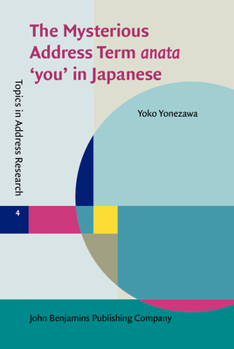
The Mysterious Address Term anata 'you' in Japanese (Topics in Address Research)
No Customer Reviews

The use of the second person singular pronoun anata 'you' in modern Japanese has long been regarded as mysterious and problematic, generating contradictory nuances such as polite, impolite, intimate, and distancing. Treated as a troublesome pronoun, scholars have searched for a semantically loaded meaning in anata , under the assumption that all Japanese personal reference terms involve social indexicality. This book takes a new approach, revealing that anata is in fact semantically simple and its powerful expressivity is explained only in pragmatic terms. In doing so, the study brings to bear a thorough understanding of key issues in pragmatics, such as common ground, sociocultural norms, and shared understandings, in order to fully grasp the meaning and usage of this single linguistic item. This book will be of interest to scholars and students in a range of linguistic fields, such as semantics, pragmatics, sociolinguistics, discourse analysis, anthropological linguistics, linguistic typology, cultural linguistics, as well as applied linguistics.
Format:Hardcover
Language:English
ISBN:9027210500
ISBN13:9789027210500
Release Date:October 2021
Publisher:John Benjamins Publishing Company
Length:226 Pages
Weight:1.15 lbs.
Dimensions:10.0" x 0.5" x 6.8"
Related Subjects
Language ArtsCustomer Reviews
0 rating
Copyright © 2026 Thriftbooks.com Terms of Use
| Privacy Policy | Do Not
Sell/Share My Personal Information | Cookie Policy | Cookie Preferences | Accessibility Statement
ThriftBooks® and the ThriftBooks® logo are registered trademarks of Thrift Books Global, LLC
ThriftBooks® and the ThriftBooks® logo are registered trademarks of Thrift Books Global, LLC
