


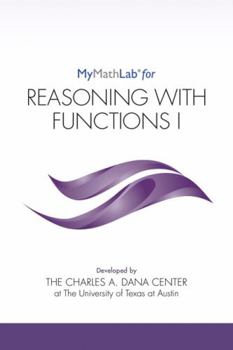
Mylab Math for Reasoning with Functions I -- Student Access Kit
No Customer Reviews

KEY BENEFIT MyMathLab for Reasoning with Functions I is part of a series of MyMathLab courses built to support the New Mathways Project developed by the Charles A. Dana Center. The New Mathways Project embodies the Dana Center's vision for a systemic approach to improving student success and completion through implementation of processes, strategies, and structures built around three mathematics pathways. Reasoning with Functions I is the first of two college-level courses designed to prepare students to enter calculus and succeed in STEM coursework that requires a thorough knowledge of functions and algebraic reasoning. Students build a strong foundation in functions and their behavior by using multiple representations and explicit covariational reasoning to investigate and explore quantities, their relationships, and how these relationships change. It is designed as a five-contact-hour course, with the Intermediate and College Algebra skills needed to prepare for Reasoning with Functions II KEY TOPICS Describing Quantities and Their Relationships; Talking About Quantities; Our Learning Community; Talking About Quantities (Continued); Functions; Functions (Continued); Working with Inputs and Outputs; Independence and Dependence; Processes; Domain and Range; More with Function Notation; Exploring Linear, Exponential, and Periodic Models; Linear Population Growth; Models of Exponential Growth and Decay; Models With Periodic Functions; Comparing Linear, Exponential, and Periodic Functions; Forming Effective Study Groups; Exploring Logarithmic Models; Introduction to Piecewise Defined Functions; Interpreting the Behavior of Logarithmic Functions; Interpreting the Behavior of Logarithmic Functions (Continued); Investigating Other Functions; Modeling Constant Change; Linear Functions and Equations; Linear Functions and Equations (Continued); Straight Talk About Lines; Straight Talk About Lines (Continued); Making Predictions with Lines; Slope and Intercept; Golfing on the Moon; Finding Intersections of Lines; Graphing With Technology; Modeling with Two Lines; Solving Systems of Linear Equations Graphically; Determining the Number of Solutions; Solving Systems Using Substitution; Elimination by Addition; Maximum Heart Rate; Using Matrices to Find Solutions; Matrices and Linear Systems; Row Echelon Form; Strategies for Solving Linear Systems; Modeling with Curves; Quadratic Functions; Properties of Quadratic Functions; Unit Cost; Shifting, Scaling, and Inverting Quadratic Functions; Transformations of Quadratic Functions; Composing and Inverting Transformations; Modeling With Quadratic Functions; Solving Quadratic Equations; Rates of Change and Total Change; Exploring Inverse Relationships; Reversing a Quadratic Function; The Inverse of a Linear Function; The Inverse of a Quadratic Function; What Is a Meter?; How Fast?; Modeling with Power Functions; Introduction to Power Functions; Introduction to Power Functions (Continued); Illuminance; Working with Volume and Optimization Models; Graphing Polynomial Functions; Building Polynomial Models; Optimization; Strategies for Factoring Polynomials; Interpreting Change in Polynomial Models; Average Rates of Change; Average Rates of Change (Continued); Modeling with Polynomial Functions; Modeling with Polynomial Functions (Continued); Working with Fractional Exponents; Fractional Exponents; Functions With Fractional Exponents; Graphs of Functions With Fractional Exponents; Understanding Discontinuities and End Behavior; Discontinuities of Rational Functions; End Behavior of Rational Functions; Exploring Asymptotic Behavior; Vertical Asymptotes; Behavior Near Vertical Asymptotes; Vertical Asymptotes vs. Holes; Strategies for Understanding Vertical Asymptotes; Modeling with Rational Functions; You're Getting Very Sleepy...; Reducing Pollution; Food Costs; Exploring Graphs of Rational Functions; Graphing Rational Functions; Extreme Values of Rational Functions; Drug Concentration; Special Relativity; Understanding Addition and Composition of Rational Functions; Composition of Rational Functions; Adding It All Up; Adding Rational Functions; Adding Rational Functions (Continued); Comparing Graphs of Functions; Exponential Functions Revisited; Other Forms of Exponential Functions; Comparing Exponential and Linear Functions; Interpreting Change in Exponential Models; Half-life and Decay Models; Doubling Time and Growth Models; Comparing Exponential Functions; Exploring Other Exponential Models; Newton's Law of Cooling; Drug Accumulation and Exponential Models; Surge Functions; Analyzing Linear Approximations of Exponential Models; Linear Approximations of Exponential Functions; Compound Interest; Exploring Logistic Growth and Oscillation; The Logistic Function; Decaying Oscillations; Decaying Oscillations (Continued); Charging and Discharging Capacitors; Inverting Exponential Functions; Inverse Exponentials; Logarithms; Graphing Logs; Log Laws; Logarithmic Scales; Solving Exponential and Logarithmic Equations; Savings Bonds; How Do You Rank?; Earthquake ; Extraneous Solutions MARKET For anyone interested in improving algebraic skills in preparation for Trigonometry courses or the Calculus sequ
Format:Hardcover
Language:English
ISBN:0134389441
ISBN13:9780134389448
Release Date:August 2016
Publisher:Pearson
Weight:0.40 lbs.
Dimensions:0.3" x 5.4" x 8.4"
Customer Reviews
0 rating
Copyright © 2025 Thriftbooks.com
Terms of Use | Privacy Policy | Do Not Sell/Share My Personal Information | Cookie Policy | Cookie Preferences | Accessibility Statement
ThriftBooks ® and the ThriftBooks ® logo are registered trademarks of Thrift Books Global, LLC
ThriftBooks ® and the ThriftBooks ® logo are registered trademarks of Thrift Books Global, LLC
