
Skip to content
Scan a barcode
Scan
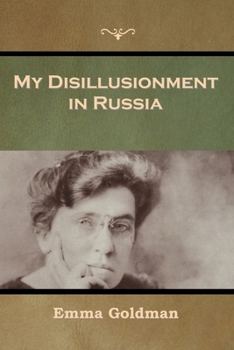
Paperback My Disillusionment in Russia Book

ISBN: B0BLR6VLNM

ISBN13: 9798888300671

My Disillusionment in Russia

Select Format

Select Condition ThriftBooks Help Icon

Recommended

Format: Paperback

Condition: New

$17.34
Ships within 2-3 days
Save to List

Book Overview

Emma Goldman (June 27 [O.S. June 15], 1869 - May 14, 1940) was an anarchist political activist and writer. She played a pivotal role in the development of anarchist political philosophy in North America and Europe in the first half of the 20th century.


Born in Kaunas, Russian Empire (now Lithuania), to a Jewish family, Goldman emigrated to the United States in 1885. Attracted to anarchism after the Chicago Haymarket affair, Goldman became a writer and a renowned lecturer on anarchist philosophy, women's rights, and social issues, attracting crowds of thousands. She and anarchist writer Alexander Berkman, her lover and lifelong friend, planned to assassinate industrialist and financier Henry Clay Frick as an act of propaganda of the deed. Frick survived the attempt on his life in 1892, and Berkman was sentenced to 22 years in prison. Goldman was imprisoned several times in the years that followed, for "inciting to riot" and illegally distributing information about birth control. In 1906, Goldman founded the anarchist journal Mother Earth.


In 1917, Goldman and Berkman were sentenced to two years in jail for conspiring to "induce persons not to register" for the newly instated draft. After their release from prison, they were arrested-along with 248 others-in the so-called Palmer Raids during the First Red Scare and deported to Russia. Initially supportive of that country's October Revolution that brought the Bolsheviks to power, Goldman changed her opinion in the wake of the Kronstadt rebellion; she denounced the Soviet Union for its violent repression of independent voices. She left the Soviet Union and in 1923 published a book about her experiences, My Disillusionment in Russia. While living in England, Canada, and France, she wrote an autobiography called Living My Life. It was published in two volumes, in 1931 and 1935. After the outbreak of the Spanish Civil War, Goldman traveled to Spain to support the anarchist revolution there. She died in Toronto, Canada, on May 14, 1940, aged 70.


During her life, Goldman was lionized as a freethinking "rebel woman" by admirers, and denounced by detractors as an advocate of politically motivated murder and violent revolution. Her writing and lectures spanned a wide variety of issues, including prisons, atheism, freedom of speech, militarism, capitalism, marriage, free love, and homosexuality. Although she distanced herself from first-wave feminism and its efforts toward women's suffrage, she developed new ways of incorporating gender politics into anarchism. After decades of obscurity, Goldman gained iconic status in the 1970s by a revival of interest in her life, when feminist and anarchist scholars rekindled popular interest. (wikipedia.org)

Customer Reviews

4 ratings

The Revolution that Failed

Emma Goldman was deported from the USA back to her native Russia in 1919. Her excitement upon returning to Russia was to assist in implementing the goals of the combined "soviets" in their quest to change Russia after 300 years of the Romanovs dynastic rule. The book you are about to read contains her personal views of the Revolution and her eye witness account of the aftermath. In it, she raises some interesting points as she contrasts the "Revolution" and "Bolshevism". These two movements were mutually destructive and contradictory in aims and methods. Every Revolution has a counter-revolution, so it seems. The Americans defeated the British Colonial masters for a Democratic slave-owning Republic, controlled by elitist politicians; the French Jacobins traded their monarchy for equally-oppressive rulers; The Russian Revolution banished one oppressive regime for another as the Tsar was overthrown and the "peoples" Revolution was shanghaied by the Bolsheviks. A small minority of the movement included Lenin and Trotsky as they took over the Revolution and subverted the intent of the originators. Much later, Stalin would do the same as he maneuvered the focus from a world-wide Revolution to one of local control, Russia. Emma's book is a day-by-day chronology of activities in which she participated during her stay in Russia. Her investigative reports revealed vital information from people involved in "orchestrating the movement" as well as from those who were its victims. Hers is a front row seat to historical events unfolding before us. The struggle for reform was messy, cruel and merciless. She gets into the "weeds" of human encounters as she travels and meet anarchists, some of whom left America to join in the "fight", and other ordinary people engaged in finding a way to survive amid the graft, corruption, and mayhem. Her purpose was to see what conditions existed that would ease the tyranny against ordinary people. However, the minutia is a bit overwhelming. As she met with Lenin and John Reed, leaders of the Bolsheviks, she endeavored to find out why anarchists were jailed and censored and actively sought their release since they had similar nihilistic aims in overturning the Tsarist Government as did the revolutionists. Her efforts failed. Her biggest disappointment was that the Communist State sought to strengthen and deepen the very ideas and conceptions which the Revolution had come to destroy. Disillusioned, she left Russia in 1921.

VERY INTERESTING

A very interesting book, clear, sincere and devastating at the moment when it was written. An honest view of what the Bolshevik Russia was doing from the point of view of a disillusioned very famous anarquist who had seen Russia as the promised land where the "ideal revolution" was taking place. If you are interested in history, don't miss it.

A diamond in the bargain bins

Anyone interested in the history of radical politics would be well advised to read this book. Loathed by the American establishment Emma is deported to the young Soviet Russia for her opposition to forced conscription during the First World War. This book is a rare first-hand account of the new Soviet Russia in its earliest pre-Stalin years. Travelling around the new Russia, Emma describes many face-to-face meetings with many of the key figures of the revolution such as Zinoviev, Lenin, Trotsky, Kolontay and Kropotkin. Unfortunately for Emma her belief that a better world must be as much "anti-state" and "anti-monopoly" as "anti-capitalist" meant she finds herself as much at loggerheads with the Bolsheviks in Russia as she had previously been with the socialists in America. As the new Russia takes shape, Emma describes the "Frankenstein monster" she witnesses as a "defeat of the revolution". This is a diamond in the bargain bins.

It was Worth the Wait!

The long awaited re-release of Emma Goldman's My Disillusionment in Russia was well worth the wait. This is simply a marvelous book. This book continues the tradition of Bakunin (a contemporary of Marx) who argued that Marxism would lead to a state authoritarianism that would be just as exploitive and alienating as bourgeois capitalistic "democracies" if not more so. Goldman shows, as she would later argue in her essay "There is No Communism in Russia," that Marxist run economies and governments merely supplant the bourgeoisie as employer and coercive authority. They do not empower workers and communities to run their own affairs along free and cooperative socialistic lines.Like many leftists during her time, Goldman initially supported the communist accession to power as preferable to the Tsarist regime. But her support was largely based on reports given by communists in the pay of the Bolsheviks. Goldman was deported from the USA because she spoke publicly against the draft. Although she probably would have won the case, she decided not appeal the deportation order because she wanted to lend her services to the Russian people and their revoution. It required little time for her to realize that Bolshevik claims for progress belied the reality in Russia. Everywhere she saw evidence of mass starvation, extreme censorship, political oppression, cronyism, mass imprisonments and executions, and the tacit contempt the Russian people had for the Bolsheviks. Her descriptions of Lenin should help to settle oft-repeated lie that Stalin was a Leninist aberration. He was the natural, if more efficient, successor of Lenin. She deftly refutes the Marxian apologetic that only countries that have experienced extensive capitalistic development are best suited to enter into a revolutionary phase. If that is so, she asks, then why haven't England, Germany and the USA experienced the social revolution Marx predicted? She demonstrates that the Bolsheviks were more concerned with power than socialism and replaced the revolution with statism. The people, not the Bolsheviks, brought about the revolution in Russia, she argues. The Bolsheviks stole and then murdered it. The narrative style of this work makes it riveting and real. Readers will get a good sense of the distinction between the libertarian socialism advocated by anarchism and the faux socialism advocated by Marxism. This is a great book.
Copyright © 2026 Thriftbooks.com Terms of Use | Privacy Policy | Do Not Sell/Share My Personal Information | Cookie Policy | Cookie Preferences | Accessibility Statement
ThriftBooks ® and the ThriftBooks ® logo are registered trademarks of Thrift Books Global, LLC

GoDaddy Verified and Secured