


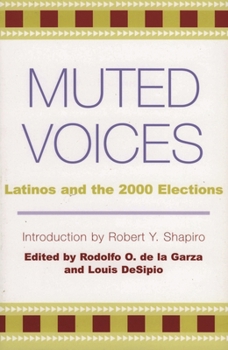
Muted Voices: Latinos and the 2000 Elections


Select Format
Select Condition 
Book Overview
The 2000 presidential election was one of the closest in history, yet this book shows that the Latino vote and voice in the election were limited in impact. In time for election year 2004, Muted Voices explores general themes and trends in American politics and Latino voter participation, while focusing on key state electoral results including Florida, Texas, and most important, California. Since 1988, de la Garza and DeSipio have led the way in interpreting the role of Latinos in U.S. elections. This new installment in their series of electoral studies is chock full of data and thematic suggestions about the future of Latino politics. An introduction by public opinion specialist Robert Y. Shapiro puts Latino voter potential in context with U.S. politics and policy.
Format:Paperback
Language:English
ISBN:0742535916
ISBN13:9780742535916
Release Date:July 2004
Publisher:Rowman & Littlefield Publishers
Length:240 Pages
Weight:1.05 lbs.
Dimensions:0.7" x 6.0" x 9.0"
Customer Reviews
1 rating
Ethnic Voting Power in a Famous Election Cycle
Published by Thriftbooks.com User , 20 years ago
This anthology looks at Latinos and their voting patterns during the 2000 elections. It is diverse in region (Southwest, Southeast, Northeast, and Midwest), and correspondingly ethnicity (Mexican, Cuban, Puerto Rican). This book is a strong example of political science and may be a great source of statistics for students writing papers. The contributors keep asking, "Did the Latino vote swing the election?" in various states. I think they are a bit pessimistic in their assessment. Just because the Latino vote may not have been a dispositive factor like the votes Gore lost to Nader does not mean those votes were not appreciated. I am confident that both Bush and Gore were happy for any vote they received from any Latino, or any American. So what one group didn't swing the election? I support the Voting Rights Act and continue to support using race as a factor in carving electoral districts. However, I think many may be afraid of the identity politics here. The contributors usually only look at whether Latinos were elected to show that the Latino vote mattered. There are other ways that Latino voices can be heard. For example, the book said New York Latinos were thrilled to vote for Hillary Rodham Clinton, a Caucasian, in 2000. It also says a white Republican, Pete Domenici, put money up to see that more Hispanic Republicans can run for office. In my state, a white woman named Janice Schakowsky is a big advocate of immigration, which the author cite as a Latino issue. I recall Congresswoman Loretta Sanchez saying her district is not primarily Latino. Coalitional politics could help Latinos, and others. Many Latino and Asian-American scholars have criticized other groups for not breaking "the black-white paradigm." The authors do not create a brown-white paradigm here: they mention Asian Americans, African Americans, and Native Americans when possible. There are two chapters about Latinos in California. They do not repeat each other. However, the first of those chapters breaks the style of the rest of the book. "One of these chapters is doing its own thing!"--Sesame Street style. Republicans got their own chapter while Democrats did not. However, this book repeats continually that Latinos usually vote Democrat, so the two identities overlap often. Now that the election in question is already half a decade in the past, I asked myself if the book is dated. I think having Salazar and Menendez as U.S. Senators and Gonzalez as the U.S. Attorney General says much about Latino voting power and the Parties' desire to court them. Still, the introduction of the book implies that the editors make a new book after every election cycle, so a book on 2004 is sure to be in the works.
Copyright © 2026 Thriftbooks.com
Terms of Use | Privacy Policy | Do Not Sell/Share My Personal Information | Cookie Notice | Cookie Preferences | Accessibility Statement
ThriftBooks ® and the ThriftBooks ® logo are registered trademarks of Thrift Books Global, LLC
ThriftBooks ® and the ThriftBooks ® logo are registered trademarks of Thrift Books Global, LLC
