


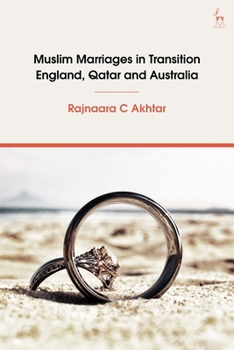
Muslim Marriages in Transition: England, Qatar and Australia
No Customer Reviews

This book undertakes a critical and comparative analysis of the legal and social treatment of informal unregistered 'religious-only' marriages by the state in England/Wales, Australia, and Qatar.
This examination of the differing outcomes for couples who live in England/Wales where cohabitants have no legal rights, Australia where cohabitants do benefit from some legal protections, and Qatar, a Muslim majority state with a modern family law regime which ordinarily recognises religious marriages provides a broad canvas for exploring this issue in depth. The book looks at this very complex issue from a range of perspectives including autonomy, cultural transitions and legal pluralism. It examines the issue of religious-only marriages in order to convey the complex and interwoven narrative which signifies how multifaceted law reform must be in order to adequately respond to these transitioning relationship norms in any given jurisdiction. Of course, relationship norms are not static and they continue to evolve. In light of changing norms and practices, the theoretical framework for this book focuses on the concept of 'liminality' or transition, which is being witnessed in the processes and formalities by which Muslims are entering their marriages.Format:Hardcover
Language:English
ISBN:1509931694
ISBN13:9781509931699
Release Date:August 2027
Publisher:Hart Publishing
Length:192 Pages
Weight:1.00 lbs.
Dimensions:1.0" x 6.1" x 9.2"
Related Subjects
LawCustomer Reviews
0 rating
Copyright © 2026 Thriftbooks.com
Terms of Use | Privacy Policy | Do Not Sell/Share My Personal Information | Cookie Notice | Cookie Preferences | Accessibility Statement
ThriftBooks ® and the ThriftBooks ® logo are registered trademarks of Thrift Books Global, LLC
ThriftBooks ® and the ThriftBooks ® logo are registered trademarks of Thrift Books Global, LLC
