


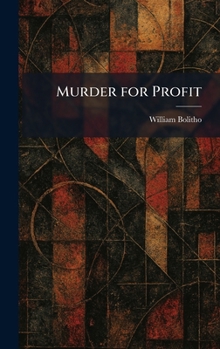
Murder for Profit


Select Format
Select Condition 
Book Overview
"Murder for Profit" is a seminal work of true crime literature that explores the chilling motivations and psychological profiles of infamous mass murderers who committed their crimes for financial gain. Written by the perceptive journalist William Bolitho, the book delves into the lives of notorious figures such as William Burke and William Hare, Jean-Baptiste Troppmann, George Joseph Smith, and Henri D sir Landru. Rather than focusing solely on the grisly details of their deeds, Bolitho examines the social and economic conditions that fostered these "professional" killers.
Through incisive prose and philosophical inquiry, Bolitho categorizes these individuals not as mere madmen, but as products of a particular kind of cold-blooded commercialism. He investigates how these men viewed their victims as commodities and their crimes as business ventures. This study remains a classic in the genre for its sophisticated analysis of the criminal mind and its reflection on the darker side of human ambition. "Murder for Profit" offers readers a profound look at the intersection of greed, morality, and the law, making it an essential read for those interested in historical criminology and the evolution of the true crime genre.
This work has been selected by scholars as being culturally important, and is part of the knowledge base of civilization as we know it. This work was reproduced from the original artifact, and remains as true to the original work as possible. Therefore, you may see the original copyright references, library stamps (as most of these works have been housed in our most important libraries around the world), and other notations in the work.
This work is in the public domain in the United States of America, and possibly other nations. Within the United States, you may freely copy and distribute this work, as no entity (individual or corporate) has a copyright on the body of the work.
As a reproduction of a historical artifact, this work may contain missing or blurred pages, poor pictures, errant marks, etc. Scholars believe, and we concur, that this work is important enough to be preserved, reproduced, and made generally available to the public. We appreciate your support of the preservation process, and thank you for being an important part of keeping this knowledge alive and relevant.
Customer Reviews
The world's first profiler?
ThriftBooks ® and the ThriftBooks ® logo are registered trademarks of Thrift Books Global, LLC
