


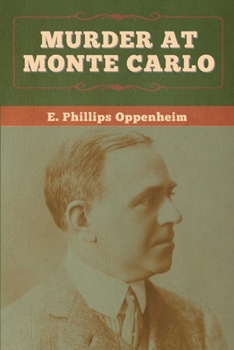
Murder at Monte Carlo

Select Format
Select Condition 
Book Overview
Edward Phillips Oppenheim (22 October 1866 - 3 February 1946) was an English novelist, a prolific writer of best-selling genre fiction, featuring glamorous characters, international intrigue and fast action. Notably easy to read, they were viewed as popular entertainments. He was featured on the cover of Time magazine in 1927.
Edward Phillips Oppenheim was born in Tottenham, London, the son of Henrietta Susannah Temperley Budd and Edward John Oppenheim, a leather merchant. After attending Wyggeston Grammar School until the sixth form in 1883, his family's finances forced him to withdraw and he worked in his father's business for almost twenty years. His father subsidized the publication of his first novel, which proved just successful enough to break even. He published five of his novels between 1908 and 1912 under the pseudonym "Anthony Partridge". Around 1900, Julien Stevens Ulman (1865-1920), a wealthy New York leather merchant who enjoyed Oppenheim's books, bought the leather works and made him a salaried director to support his writing career. He quickly found a successful formula and established his reputation. In 1913, John Buchan, launching his career as a suspense novelist, called Oppenheim "my master in fiction" and "the greatest Jewish writer since Isaiah". As early as that year, his publishers were bringing out new editions of some of his earlier works to meet, in the words of one trade publication, "the insatiable demand of the public for more stories by him". It added: "Readers of the author's recent books will find these first stories of life sketches full of interest, their very crudeness being positively amusing in light of his present finished craftsmanship."
He described his method in 1922: "I create one more or less interesting personality, try to think of some dramatic situation in which he or she might be placed, and use that as the opening of a nebulous chain of events." He never used an outline: "My characters would resent it." When he needed villains for his diplomatic and political intrigues he drew on Prussian militarists and anarchists, enough for one reviewer to lament "the baldness of his propaganda". For example, in A People's Man (1915), a socialist discovers that his movement is secretly run by German spies. (wikipedia.org)
Customer Reviews
ThriftBooks® and the ThriftBooks® logo are registered trademarks of Thrift Books Global, LLC
