


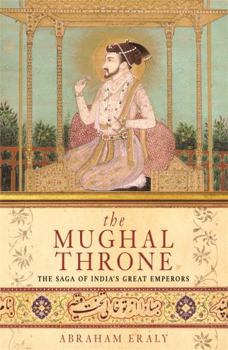
The Mughal Throne: The Saga of India's Great Emperors

Select Format
Select Condition 
Book Overview
A history of the great Mughal rulers of India, one of the world's greatest empires.
In December 1525 Babur, the great grandson of the Mongol conqueror Tamberlaine, crossed the Indus river into the Punjab with a modest army and some cannon. At the battle of Panipat five months later he routed the mammoth army of the Afghan ruler of Hindustan. Mughal rule in India had begun. It was to continue for over three centuries, shaping India for all time. Full of dramatic episodes and colourful detail, THE MUGHAL EMPIRE tells the story of one of the world's great empires.Format:Paperback
Language:English
ISBN:0753817586
ISBN13:9780753817582
Release Date:February 2004
Publisher:Phoenix
Length:608 Pages
Weight:1.64 lbs.
Dimensions:1.8" x 5.4" x 8.4"
Customer Reviews
5 ratings
THE MUGHAL THRONE: the saga of india's great emporors
Published by Thriftbooks.com User , 17 years ago
This is an extremely well written book which takes you back into the 14th century, let you discover the great Mughals and brings back the Mughal empire into life. I read about how they came into power through their shear toughness, bravery and the will to rule the Indian subcontinent. I also read how they fell apart, through virtue of their barbarian nature. This book will tell you how Babur found the land of peace and prosperity in Indian and made it his home. Humayun, intellectual but with mongolian traits would back and forth between India and Iran. Akbar, the great, would later take the empire to it's majestic heights. The later Mughals, Jahangir, ShahJahan and Aurangzeb will add joy and misery in this saga that comes to an extremely tragic end. I truly enjoyed reading this book and I highly recommend it.
How the Mughals made India
Published by Thriftbooks.com User , 18 years ago
This is a fascinating book involving a fascintating period in the history of India. During the heyday of Mughal rule, India was one of the world's leading civilizations. Here was an elite that ruled intelligently (at least at first), allowing Moslem and Hindu worship freely and equally and producing some of the great monuments of civilization, the Taj Mahal, the Red Fort, and the city constructed by one of the emperors, Akbar, Fatehpur Sikri. The focus of the book is the emperors themselves. It begins with Babur, who came out of Central Asia, a descendent of Tamerlane, who established the dynasty in North India. Babur also wrote an autobiography which detailed the principle events of his life which makes fascinating reading even today (Modern Library has recently reissued it in paperback). Babur was succeded by his son Humayun, who has to be one of the most unlucky rulers of the 16th century. There was the usual strife between him and his siblings (which became the standard way of doing business as time progressed) which undermined the stability of the throne. Humayan spent a lengthy period in Persia which had longstanding cultural implications for the Mughals. Fortunately for the dynasty,during its exile Sher Khan, whose 5 year rule allowed for certain administrative reforms that allowed the restored Mughal dynasty a certain degree of financial independence and the resources to build the great monuments and to extend its control from the north of India down to south. Many historians have downplayed Sher Khan's legacy, but Eraly is quite thorough in addressing this point. Humayan died of a freak accident while pursuing his hobby of astonomy. His son Akbar assumed the throne and with him, his son, Jahangir, and grandson, Shah Jahan were the great days of the Mughals. It is the successes of that these remarkable rulers enjoyed, ruling much of modern India, that we remember this dynasty. Here Eraly handles the variety of court intrigues, building marvels, and sensual pleasures that made up the day to day life of an Indian Mughal emperor. The section on Akbar is particularly well-done, dealing with the cultured, yet illiterate emperor's wise appreciation of the religious questions. Akbar's ability to understand the need to balance the Moslem religion of the rulers with the Hiduism of the ruled is in marked contrast with the final emperor detailed in the book, Aurangzeb. Embarking on a policy of religious intolerance and military expeditions lead to isolation from his Rajput allies and ultimately the demise of the empire in 1857 and the establishment of British rule in India. This is an excellent work which shows how the the Mughals were able to achieve all that they did and how they were undone by one of their own.
Mughal History Made Readable and Fascinating
Published by Thriftbooks.com User , 19 years ago
The Mughal Throne is a well-researched, highly readable, extremely informative and detailed account of the great Mughal emperors from Babur through Aurangzeb. Abraham Eraly is a first-rate historian; he sets out his view of the historian's task in the erudite but readable "Preface" to the book. But not only is Eraly a first-rate historian - he is a first-rate storyteller, as well. Even the sections on military history (which I normally avoid) are written in a detailed but fascinating manner. I particularly like the way in which the various emperors' unique personalities come alive for the reader. The Mughal Throne is as engrossing and lively as any of the several historical novels set in Mughal times that I have recently read. I highly recommend this book not only for those interested in Islamic or Indian history, but for any tourist planning to visit Delhi, Agra, and/or Lahore. The many Mughal historical monuments in these cities will be enlivened for them because of their having read this excellent book.
"Uneasy lies a head that wears a crown."
Published by Thriftbooks.com User , 20 years ago
Arguably India's Golden Age, the near two-hundred years of the Mughal Empire from Babur to Aurangzeb was a time when the richest got richer, conquered and ruled SE Asia from Kabul to Konyakumari, built cities, forts, and fabulous tombs, lived fairly short lives, wept over trivialities, warred amongst themselves, blinded, maimed, and executed family members; and, after Aurangzeb, lost it all except in name. "The Mughal Throne: The Saga of India's Great Emperors," is the first released third volume of a four part history of India, and though it is far from the definitive work on the Mughals it is a well written, and exciting saga - just what the title says it would be - a narrative that hits all the high points, and delves into just enough detail not to loose the casual historian or India-phile. If you want to know India, especially Northern India, you must know the Mughals, and they're a family worth knowing. (If you like the Medici's, you'll love the Mughals.) Their reign was short in the scheme of Indian history, but stamped the country for all time.
An excellent read.
Published by Thriftbooks.com User , 22 years ago
This is an excellent book for anyone who is interested in the events in India just before the British came a'colonizing.It is an excellent mixture of vivid story telling and clear factual progression. Eraly does more than simply recount dates and facts; he makes the people who moved these events come alive like the characters in a good novel.I hadn't read any histories of India before this one, and I found it very easy to jump in and follow what was going on.I believe this book is pretty much the same as Emperors of the Peacock Throne, just with a different title, so if this one remains unavailable Peacock Throne would be a good option.Enjoy!
Copyright © 2026 Thriftbooks.com Terms of Use
| Privacy Policy | Do Not
Sell/Share My Personal Information | Cookie Policy | Cookie Preferences | Accessibility Statement
ThriftBooks® and the ThriftBooks® logo are registered trademarks of Thrift Books Global, LLC
ThriftBooks® and the ThriftBooks® logo are registered trademarks of Thrift Books Global, LLC
