


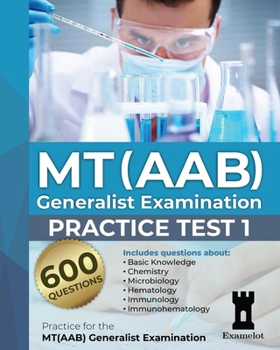
MT(AAB) Generalist Examination: Practice test 1
No Customer Reviews

MT(AAB) Generalist Examination Practice Test: Prepare for Success Looking for an effective way to prepare for the AAB Medical Technologist Generalist exam? If yes, then this unofficial book of practice questions is for you. With 600 multiple-choice questions - 100 questions per section - this book covers all the major topics you can expect to encounter on the MT(AAB) exam, including chemistry, microbiology, hematology, immunology, and immunohematology. Each question is designed to resemble the types of questions you'll encounter on the actual exam, so you can practice with confidence and get a feel for the exam format. Difficult questions are accompanied by an explanation, allowing you to understand the answer and the reasoning behind it. Features: 600 practice questions, including image-based questions and case studies, aligned with the official MT(AAB) exam guidelinesAnswers and explanationsInformation about the MT(AAB) examAn index for easy referenceContent tailored to American standards, including American units and reference ranges
Sample questions As an idea of the type of questions in the book, below are six questions from the book. 1) BASIC KNOWLEDGE
Which glassware is used to measure 24-hour urine volumes?
a. Beaker
b. Erlenmeyer flask
c. Graduated cylinder
d. Graduated pipette
Answer: c) Graduated cylinder
Graduated cylinders are used to measure 24-hour urine volumes because they are designed to make accurate measurements of large volumes of liquids. They typically come in three sizes (500 mL, 1000 mL, and 2000 mL) and can measure in 5 mL, 10 mL or 20 mL increments. 2) CHEMISTRY
Which of these increases in a urine specimen left at room temperature?
a. Bilirubin
b. Ketones
c. Leukocytes
d. Nitrites
Answer: d) Nitrites
Nitrites will increase in urine left at room temperature due to bacterial production. 3) MICROBIOLOGY
After Gram staining, what colour are gram-negative organisms?
a. Green
b. Light blue
c. Purple or brown
d. Red or pink
Answer: d) Red or pink
In Gram staining, a primary stain stains gram-positive organisms purple and a counterstain stains the gram-negative organisms red or pink. You can remember this by "keeping your P's together" Purple is Positive. 4) HEMATOLOGY
Which anticoagulant is used for red blood cell counts?
a. EDTA
b. Heparin
c. Sodium citrate
d. Sodium fluoride
Answer: a) EDTA
EDTA is the best anticoagulant for preserving the morphology of blood cells. For this reason, red blood cell counts are collected in a tube containing EDTA. 5) IMMUNOLOGY
Which leukocytes are nongranular?
a. Basophils and mast cells
b. Basophils and monocytes
c. Lymphocytes and monocytes
d. Neutrophils and eosinophils
Answer: c) Lymphocytes and monocytes
The nongranular leukocytes are lymphocytes and monocytes. These leukocytes have no obvious granules in their cytoplasm.
The granular leukocytes are neutrophils, eosinophils, basophils, and mast cells. 6) IMMUNOHEMATOLOGY
Which of these tests can detect heterophile antibodies?
a. ABO typing
b. Indirect antiglobulin test
c. Karyotype test
d. Mononucleosis test
Answer: d) Mononucleosis test
The mononucleosis test detects heterophile antibodies produced in response to an Epstein-Barr virus infection, the virus that causes mononucleosis.
Sample questions As an idea of the type of questions in the book, below are six questions from the book. 1) BASIC KNOWLEDGE
Which glassware is used to measure 24-hour urine volumes?
a. Beaker
b. Erlenmeyer flask
c. Graduated cylinder
d. Graduated pipette
Answer: c) Graduated cylinder
Graduated cylinders are used to measure 24-hour urine volumes because they are designed to make accurate measurements of large volumes of liquids. They typically come in three sizes (500 mL, 1000 mL, and 2000 mL) and can measure in 5 mL, 10 mL or 20 mL increments. 2) CHEMISTRY
Which of these increases in a urine specimen left at room temperature?
a. Bilirubin
b. Ketones
c. Leukocytes
d. Nitrites
Answer: d) Nitrites
Nitrites will increase in urine left at room temperature due to bacterial production. 3) MICROBIOLOGY
After Gram staining, what colour are gram-negative organisms?
a. Green
b. Light blue
c. Purple or brown
d. Red or pink
Answer: d) Red or pink
In Gram staining, a primary stain stains gram-positive organisms purple and a counterstain stains the gram-negative organisms red or pink. You can remember this by "keeping your P's together" Purple is Positive. 4) HEMATOLOGY
Which anticoagulant is used for red blood cell counts?
a. EDTA
b. Heparin
c. Sodium citrate
d. Sodium fluoride
Answer: a) EDTA
EDTA is the best anticoagulant for preserving the morphology of blood cells. For this reason, red blood cell counts are collected in a tube containing EDTA. 5) IMMUNOLOGY
Which leukocytes are nongranular?
a. Basophils and mast cells
b. Basophils and monocytes
c. Lymphocytes and monocytes
d. Neutrophils and eosinophils
Answer: c) Lymphocytes and monocytes
The nongranular leukocytes are lymphocytes and monocytes. These leukocytes have no obvious granules in their cytoplasm.
The granular leukocytes are neutrophils, eosinophils, basophils, and mast cells. 6) IMMUNOHEMATOLOGY
Which of these tests can detect heterophile antibodies?
a. ABO typing
b. Indirect antiglobulin test
c. Karyotype test
d. Mononucleosis test
Answer: d) Mononucleosis test
The mononucleosis test detects heterophile antibodies produced in response to an Epstein-Barr virus infection, the virus that causes mononucleosis.
Format:Paperback
Language:English
ISBN:B099TMN14Q
ISBN13:9798540319621
Release Date:July 2021
Publisher:Independently Published
Length:214 Pages
Weight:0.96 lbs.
Dimensions:0.5" x 8.0" x 10.0"
Customer Reviews
0 rating
Copyright © 2026 Thriftbooks.com Terms of Use
| Privacy Policy | Do Not
Sell/Share My Personal Information | Cookie Policy | Cookie Preferences | Accessibility Statement
ThriftBooks® and the ThriftBooks® logo are registered trademarks of Thrift Books Global, LLC
ThriftBooks® and the ThriftBooks® logo are registered trademarks of Thrift Books Global, LLC
