


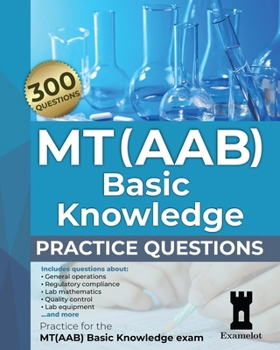
MT(AAB) Basic Knowledge practice questions: Practice for the MT(AAB) Basic Knowledge exam
No Customer Reviews

This practice book is designed to help you prepare for the MT(AAB) Basic Knowledge Examination. Inside, you'll find 300 multiple-choice practice questions designed to reflect the knowledge and skills tested on the examination. Each question has an answer and explanation, helping you understand not only the answer but also the reasoning behind it. The questions cover the major topics identified by AAB for the Basic Knowledge examination, including laboratory operations, calculations, QC/QA, CLIA, OSHA, safety, specimen management, confidentiality, communication, instrumentation, weights and measures, patient test management, specimen handling, regulatory compliance, and information security. Whether you're just beginning your studies or in the final stages of review, this book gives you the opportunity to identify areas for improvement, reinforce key concepts, and become more familiar with the type of knowledge required for the examination. WHAT YOU'LL GET
- 300 multiple-choice practice questions covering the major areas of the MT(AAB) Basic Knowledge examination.
- Answers and explanations to help you understand the reasoning behind each answer.
- A list of topics on the Basic Knowledge exam Ideal for anyone preparing for the MT(AAB) Basic Knowledge Examination, this book provides focused practice across the subjects you need to review. SAMPLE QUESTIONS
To give you a preview, here are five sample questions from the book: Question 1. The monitoring of laboratory processes to ensure the accuracy of test results is an aspect of:
a) corporate compliance
b) critical thinking
c) quality assurance
d) risk management Question 2. What do double rings on a pipette mean?
a) The last drop must be blown out
b) The pipette can hold 2 mL
c) The pipette will deliver the measured amount of liquid only at 20 C
d) The volume is measured at this point Question 3. Which CLIA certificate allows laboratories to conduct moderate or high complexity tests before the laboratory is inspected and a final certificate is issued?
a) Accreditation
b) Compliance
c) Registration
d) Waiver Question 4. Under CLIA regulations, how many categories of laboratory test complexity are there?
a) 2
b) 3
c) 4
d) 5 Question 5. For data distributed normally, what percentage of values fall within two standard deviations of the mean?
a) 50%
b) 68%
c) 83%
d) 95% Answers
1) c. quality assurance
Quality assurance helps ensure that processes produce reliable and accurate results. In laboratories, quality assurance involves monitoring, evaluating, and improving the testing process, from sample collection to final reporting. 2) a. The last drop must be blown out
A pipette with two etched rings is a "blow-out" pipette. This means after you have drawn up and dispensed the liquid, you need to blow out the remaining liquid clinging to the pipette walls by blowing with a rubber bulb. 3) c. Registration
Certificates of Registration are issued to allow the laboratory to perform non-waived testing until the laboratory is surveyed. Once the laboratory is inspected and found in compliance, a final certificate of compliance or accreditation is issued. 4) b. 3
CLIA divides tests into three categories of complexity: waived, moderate complexity, and high complexity. 5) d. 95%
For data distributed normally, 95% of the data falls within two standard deviations of the mean.
- 300 multiple-choice practice questions covering the major areas of the MT(AAB) Basic Knowledge examination.
- Answers and explanations to help you understand the reasoning behind each answer.
- A list of topics on the Basic Knowledge exam Ideal for anyone preparing for the MT(AAB) Basic Knowledge Examination, this book provides focused practice across the subjects you need to review. SAMPLE QUESTIONS
To give you a preview, here are five sample questions from the book: Question 1. The monitoring of laboratory processes to ensure the accuracy of test results is an aspect of:
a) corporate compliance
b) critical thinking
c) quality assurance
d) risk management Question 2. What do double rings on a pipette mean?
a) The last drop must be blown out
b) The pipette can hold 2 mL
c) The pipette will deliver the measured amount of liquid only at 20 C
d) The volume is measured at this point Question 3. Which CLIA certificate allows laboratories to conduct moderate or high complexity tests before the laboratory is inspected and a final certificate is issued?
a) Accreditation
b) Compliance
c) Registration
d) Waiver Question 4. Under CLIA regulations, how many categories of laboratory test complexity are there?
a) 2
b) 3
c) 4
d) 5 Question 5. For data distributed normally, what percentage of values fall within two standard deviations of the mean?
a) 50%
b) 68%
c) 83%
d) 95% Answers
1) c. quality assurance
Quality assurance helps ensure that processes produce reliable and accurate results. In laboratories, quality assurance involves monitoring, evaluating, and improving the testing process, from sample collection to final reporting. 2) a. The last drop must be blown out
A pipette with two etched rings is a "blow-out" pipette. This means after you have drawn up and dispensed the liquid, you need to blow out the remaining liquid clinging to the pipette walls by blowing with a rubber bulb. 3) c. Registration
Certificates of Registration are issued to allow the laboratory to perform non-waived testing until the laboratory is surveyed. Once the laboratory is inspected and found in compliance, a final certificate of compliance or accreditation is issued. 4) b. 3
CLIA divides tests into three categories of complexity: waived, moderate complexity, and high complexity. 5) d. 95%
For data distributed normally, 95% of the data falls within two standard deviations of the mean.
Format:Paperback
Language:English
ISBN:B0BPW615NY
ISBN13:9798368346571
Release Date:December 2022
Publisher:Independently Published
Length:106 Pages
Weight:0.50 lbs.
Dimensions:0.2" x 8.0" x 10.0"
Customer Reviews
0 rating
Copyright © 2026 Thriftbooks.com
Terms of Use | Privacy Policy | Do Not Sell/Share My Personal Information | Cookie Notice | Cookie Preferences | Accessibility Statement
ThriftBooks ® and the ThriftBooks ® logo are registered trademarks of Thrift Books Global, LLC
ThriftBooks ® and the ThriftBooks ® logo are registered trademarks of Thrift Books Global, LLC
