


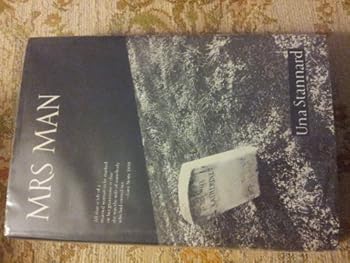
Mrs Man


No Synopsis Available.
Format:Hardcover
Language:English
ISBN:091414202X
ISBN13:9780914142027
Release Date:January 1977
Publisher:Germainbooks
Length:384 Pages
Weight:1.86 lbs.
Dimensions:9.3" x 1.0" x 6.3"
Customer Reviews
2 ratings
A truly great book of the history of women and last names
Published by Thriftbooks.com User , 16 years ago
I read this many years ago when the Women's Movement was on fire in the U.S. (I believe it's still burning, by the way, but has seeped into our cultures' consciousness to the point where it's not as visible but it's still alive and kicking). Anyway, it helped me decide to give myself my own last name when I divorced my children's father. Many feminists used their mother's first name with child and that worked for me, even though I'd always been more emotionally connected with my dad. Anyway, I was working in child abuse work in a very conservative county in Maryland and a woman I worked with, who happened to be very traditional, was getting married. I asked if she was keeping her name. She said she hadn't even thought about it, so I lent her Stannard's book. The woman decided to keep her family name. (this was a very big deal at the time and for her family and friends). Stannard does us a great service by the research she did on women and names. One salient memory I have is her going through old cemetaries where tombstones had "Mrs. John Brown" or "Mrs. George Smith"...These women probably weren't that visible as human beings when they were alive but there seems to be something really awful about the fact that even in death, their identity is hidden beneath their husband's name. When the magazine "Ms." hit the college campuses and bookshelves, many scoffed and blew it off but most thinking women and men now accept this designation as perfectly acceptable. So, things have changed some. I hope more women start to care about women's history. In women studies, it is one of the most important courses for young women to begin to get the picture of where we've been and where we want to be. This is very similar to Afro-Americans who understand the vital aspect of learning their own history. Freud once asked "What do Women Want?" Well, we've been finding that out and it starts with our history. (Who was it said "those who are ignorant of the lessons of the past are condemned to repeat them?") As true today as ever.
A great book till it gets near the end
Published by Thriftbooks.com User , 20 years ago
It's unfortunate such a great book is out of print, especially considering that it's rare to find a book on this topic. If more people, both men and women, read this book, they might come to have a new perspective on the issue of personal names and one's autonomy over them. This is a really great survey on the history of women keeping and changing their last names, usually for marital reasons, as well as bringing us the stories of couples who have chosen to go other ways. We learn about men who have taken their wives' names, couples who have taken on a new name altogether, and couples who have joined both of their names with a hyphen. One of the most fascinating stories for me was that of Mary Baker Eddy, whom we all know as the founder of Christian Science. Yet she actually got famous for founding her new religion as Mrs. Glover, but since she experienced several subsequent marriages, her identity changed (one of these names was Patterson), and by the time she was finally no longer married to anyone and wanted her original name, Baker, back (both because it was her real name and because she was newly interested in her Welsh heritage), she was told that couldn't happen. This book also has wonderful material on the early years of the Lucy Stone League, as well as Lucy Stone herself. (I was interested to learn that she began calling herself Mrs. Stone after her marriage, even though she hadn't changed her name, since she felt that becoming a Mrs. was a natural part of getting married.) As Ms. Stannard proves, women keeping their surnames at marriage, husbands taking their wives' surnames, and couples who find other solutions to this so-called "dilemma" are not part of a modern-day phenomenon but have been going on for quite some time, although it wasn't an everyday occurrence either. Still, Lucy Stoners were a lot more prevalent in the late 19th century and early 20th century than people would like one to believe. Although at least today it's no longer run as a "shocker" on the front page when a woman keeps her surname. What turned me off a bit was some of the stuff near the end. Maybe back in the Seventies it didn't seem so radical and weird, but really, in hindsight, a number of books and articles that came out during this era now seem really dated, like the authors went a bit overboard in this time of exciting new possibilities and old expectations shattered. For example, Ms. Stannard talks about how marriage is a form of slavery and that men would laugh at pregnant women in the Middle Ages, as well as being really offended over how many men will say, "This is the mother of my children," as though they're his kids alone. I don't get that impression at all when a man says that; it's just like when a woman says a man is the father of her children. I think that sentiment is more about loving and respecting that person for having helped to create one's children than expressing sole ownership over the children or being the only parent
Copyright © 2026 Thriftbooks.com
Terms of Use | Privacy Policy | Do Not Sell/Share My Personal Information | Cookie Policy | Cookie Preferences | Accessibility Statement
ThriftBooks ® and the ThriftBooks ® logo are registered trademarks of Thrift Books Global, LLC
ThriftBooks ® and the ThriftBooks ® logo are registered trademarks of Thrift Books Global, LLC
