


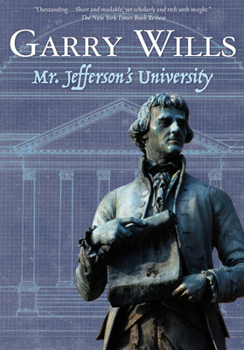
Mr. Jefferson's University


Select Format
Select Condition 
Book Overview
In the paperback edition of the critically acclaimed hardcover, bestselling author and Pulitzer Prize-winner Garry Wills explores Thomas Jefferson's final and favorite achievement, the University of Virginia. The University of Virginia is one of America's greatest architectural treasures and one of Thomas Jefferson's proudest achievements. At his request his headstone says nothing of his service as America's first Secretary of State or its third President. It says simply: "Here was buried Thomas Jefferson, author of the Declaration of American Independence, of the Statute of Virginia for Religious Freedom, and Father of the University of Virginia." For this political genius was a supremely gifted artist as well, and of all Jefferson's stunning accomplishments, the school he built in Charlottesville is perhaps the most perfect expression of the man himself: as leader, as architect, and as philosopher. In this engrossing, perceptive book, Garry Wills once again displays the keen intelligence and eloquent style that have won him great critical praise as he explores the creation of a masterpiece, tracing its evolution from Jefferson's idea of an "academical village" into a classically beautiful campus. Mr. Jefferson's University is at once a wonderful chronicle of the birth of a national institution and a deft portrait of the towering American who brought it to life. "There is much auspicious history to explore here, and Wills does so with great narrative skills." -Richmond Times-Dispatch "His command of the subject is formidable." -Los Angeles Times
Format:Paperback
Language:English
ISBN:0792255607
ISBN13:9780792255604
Release Date:August 2006
Publisher:National Geographic Society
Length:168 Pages
Weight:0.60 lbs.
Dimensions:0.6" x 5.5" x 8.0"
Customer Reviews
4 ratings
A historians view of Jefferson's vision for UVA - fun read
Published by Thriftbooks.com User , 21 years ago
In this short book, historian Garry Wills describes the vision, design, development, and legacy that Thomas Jefferson created with the University of Virginia. First, I admit that I am somewhat biased about UVA since I had the chance to attend Mr. Jefferson's university as both an undergraduate and graduate student. Having said that, it actually helps if you have spent sometime in Charlottesville strolling the grounds before you read this book. Otherwise, the reader may find it difficult gaining a true picture of the architectural design and layout of Jefferson's academical village. This book is a nice tribute to Jefferson's hard work and determination in creating a world-class university. Of course all of his political savvy was necessary to see his vision to fulfillment. Simply put, UVA was a monumental project to complete. Two complaints I have about the book center more around the design than the actual content. First - more pictures would be better in a book of this type. Second, why make a book that includes so much discussion about architecture so small. If anything this book should be an oversized coffee table style book in order to give the reader (especially those who have not seen UVA) a better "look" at UVA. I highly recommend this book to anyone interested in UVA, and the history of how the school was started. If you are an alumnus you will surely enjoy this book, and it doesn't take long to read through it. Of course, you will want to return to Charlottesville for a stroll down the lawn after finishing this book, so plan accordingly. Wahoowa.
Jefferson's Academical Village
Published by Thriftbooks.com User , 21 years ago
Thomas Jefferson's reputation in America has declined greatly over the last two decades. It is now commonplace, both among scholars and the reading public, to criticize Jefferson and place him on a lower mantle of historical accomplishment, along with several of his contemporaries. His friend, James Madison, whose reputation has long lived in the shadow of Jefferson's, is now widely considered to be the superior political thinker of the two. Former political opponents, such as John Adams and Alexander Hamilton, are now sometimes favorably compared to him. The ongoing controversy over Jefferson's affair with the slave Sally Hemings has also contributed to his reputation's decline. But as an artist, Jefferson's historical reputation has only been strengthened in recent years. He is considered one of America's greatest architects, and his work at Monticello and the University of Virginia has been voted by modern architects as the premiere achievement in American architecture. Jefferson himself seems to have had some sense of the importance of this work when he requested his tombstone read: HERE WAS BURIED THOMAS JEFFERSON AUTHOR OF THE DECLARATION OF INDEPENDENCE OF THE STATUTE OF VIRGINIA FOR RELIGIOUS FREEDOM AND FATHER OF THE UNIVERSITY OF VIRGINIA This is Garry Wills' third book on Jefferson. Wills wholeheartedly admires Jefferson's work as an architect. No one else in the Western tradition, Wills says, has ever combined the artistic and political talents of Jefferson. Unlike artist-politicians like Benjamin Disraeli, Jan Paderewski or Václav Havel, who were primarily artists before becoming politicians, Jefferson worked at both his entire life. According to Wills, the Virginian was no mere dilettante dabbling at design, but an experienced, masterful innovator of forms. He worked on his first university design project in his mid-twenties, a few years before writing the Declaration of Independence. While serving as president, he helped Benjamin Latrobe design the federal city. And he would cap off his long life with his finest work, the "academical village" - the University of Virginia in Charlottesville, the subject of this work. It took Jefferson nine years to complete his masterpiece. From the age of seventy-four to eighty-three, the design and building of the university dominated the final years of his life. He would die soon after it was completed. To do so, Jefferson had to outmaneuver the extremely hostile Virginia legislature to acquire the state money to finance his project; he also had to face down religious interests -- who were concerned about his decision to build a secular school; and he outlasted several local powers - particularly fellow builders and other state-financed universities - who sought to undermine his efforts in order to satisfy their own interests. Jefferson's local political struggles to build his university actually take up more of the book than details about its design. Jefferson wanted to build a univer
An in-depth look at one of Jefferson's proudest legacies
Published by Thriftbooks.com User , 23 years ago
This book provides a detailed and in-depth look at Thomas Jefferson's University of Virginia.The Prologue provides an overview of the architecture of the Academical Village, including the Pavilions, the Lawn and the Range, and Serpentine Walls, etc.Chapter One chronicles the extraordinary efforts that Jefferson had put in to create the University. He had to fight every step of the way for funding, for site selection, and for recruiting faculties that he wanted, not what the Virginian Assembly had in mind at the time.Chapter Two looks at how he had envisioned his University to be; how the architecture tied in with his vision of a school as a counter-weight to the establishments in the north (Yale/Harvard) and the Old World.Chapter Three drew parallels between Jefferson's plantation Monticello and the Academical Village. Chapter Four details one of the most talented architects, Latrobe's contribution to the architecture of the University, and subsequent and controversial remodelings of the Rotunda by Stanford White.Chapter Five discusses the first faculties and students. Recruiting the faculties had been difficult since the University was so new and luring talents from the north was almost impossible. In addition, Jefferson's vision of having an institute for southern plantation owners resulted in a violent culture in the University in the first years.The Epilogue looks at the University after Jefferson, how it grew and kept up its promise.This is an excellent book about UVa. As an alumni, I am embarrassed to say that before reading this book, I had not paid enough attention to the Lawn. For example, I always thought that all the Pavilions were identical. I was not aware of the educational values of the serpentine walls. I heard of Stanford White's redesigning of the Rotunda, but until this book I've never seen a picture of it. And above all, I could not have imagined how much difficulties Jefferson had encountered, and how proud he was at achieving this impossible dream. I would highly recommend this book to UVA students and alumni, and all who's visiting Charlottesville. I am so proud of being a UVa grad!
A small treasure of a book about an idea and a reality
Published by Thriftbooks.com User , 23 years ago
Although a slim volume, Gary Wills has packed this book full with information about this period in Jefferson's life that most other biographers - and I've read 22 - missed. Starting a university from scratch is just about more than one man, even Jefferson, could handle. He had to design the buidings, the dorms and rooms for the students and professors, and then hire the professors from all over the world, then make sure it ran properly even down to the rowdiness of the students. And all of this in the decade prior to his death, while he was in his 70's. That the university continues today in his spirit is a strong testament to his original thinking, his designs, and his vision for the future. This is a short book that can easily be read in one sitting, and well worth it.
Copyright © 2026 Thriftbooks.com Terms of Use
| Privacy Policy | Do Not
Sell/Share My Personal Information | Cookie Policy | Cookie Preferences | Accessibility Statement
ThriftBooks® and the ThriftBooks® logo are registered trademarks of Thrift Books Global, LLC
ThriftBooks® and the ThriftBooks® logo are registered trademarks of Thrift Books Global, LLC
