


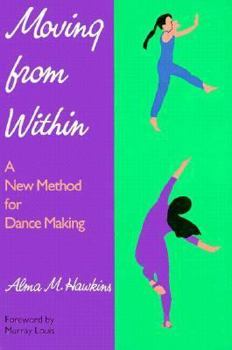
Moving from Within: A New Method for Dance Making


Select Format
Select Condition 
Book Overview
A new approach to creating dances for teachers and students of creative movement, modern dance, ballet, jazz, and aerobics from the founder of the UCLA Department of Dance. This description may be from another edition of this product.
Format:Paperback
Language:English
ISBN:1556521391
ISBN13:9781556521393
Release Date:January 1991
Publisher:A Cappella Books
Length:150 Pages
Weight:0.53 lbs.
Dimensions:9.3" x 0.8" x 6.0"
Customer Reviews
1 rating
A good introduction
Published by Thriftbooks.com User , 22 years ago
The editor of this book wastes no time in stating the author's theme of the book: that creativity is a private affair (and this is a general statement, and not just applicable to dance). Who knows better than the person in knowing how to interpret the "intricate morass" that constitutes him/her? Expressing their internal sensations and intuitions though are difficult for the individual however, for meanings of words can be altered as they are filtered through the individual personality. But in a book words must be used of course, and the author does so with great skill throughout. It is perhaps suprising that a choreographer would write about creativity and attempt to teach it as a skill that can be learned. The best choreographers consider creativity maybe as a momentary release, as a kind of play, defying explanation, and they are usually not to motivated to do so. This author though explains that throughout her life her main ambition was to find new ways of facilitating creative growth. To instruct others how to be creative entails that one understand the nature of the creative process. This is nontrivial, and so it is not surprising that the author would overview briefly various research opinions on the subject. The creative potential is influenced by the environment and one's interaction with it. One's experiences can be expressed symbolically, but this may not always be done effectively with words: one may need to use motion, sound, or painting. Dance choreography to the author is, following the classification of the philosopher/logician Susanne Langer, a "presentational form of symbolization", which is inherently metaphorical, and feelings are presented via the use of images and illusion. Imitation, conformity, and fitting into preconceived patterns can have no intersection with creativity argues the author. It requires the imagination, the sensing and feeling, and the restless desire for truth. She definitely believes in an unconscious contribution to the creative act, but also a "pre-conscious" mode of thought that integrates fragmentary knowledge and isolated elements of experience and brings about the rise of new conceptions. This middle ground between the conscious and unconscious, the Ruggian "transliminal mind", is the origin of creativity according to the author. The author makes reference to research in neuroscience regarding the hemispheric specialization of the brain, and its possible connection of creativity with the right hemisphere. She does mention though that current research points to the fact that specific localization may not be valid. The current research in neuroscience into the nature of creativity is fascinating and this book just touches on it. No doubt experimental techniques in cognitive science will settle the issue in the upcoming decades. The author is not content with merely theorizing about dance and creativity, but in teaching students to find out and utilize their own. She lists several different classro
Copyright © 2026 Thriftbooks.com Terms of Use
| Privacy Policy | Do Not
Sell/Share My Personal Information | Cookie Policy | Cookie Preferences | Accessibility Statement
ThriftBooks® and the ThriftBooks® logo are registered trademarks of Thrift Books Global, LLC
ThriftBooks® and the ThriftBooks® logo are registered trademarks of Thrift Books Global, LLC
