


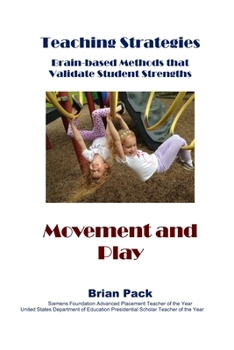
Movement and Play
No Customer Reviews

The cerebellum is not just a motor 'control panel' but also a switchboard connecting the reasoning and judgment features of the frontal cortex as well as the emotional midbrain areas and is consequently tied to learning. Neuromuscular coordination and vestibular functionality are linked to the attentive academic child.
Research reveals that adding a modest portion of time to an assortment of motions that emphasize vestibular stimulation in the classroom and playground such as spinning, rope jumping, balancing, somersaulting, rolling and walking on balance beams, swinging on low jungle gyms, climbing, skating, and performing somersaults throughout an instructional day improves academic performance significantly.Conditioning the cerebellum through motion builds the attentive capacity of a child by developing synaptic connections across the reticular activating system from the frontal lobes to the midbrain. It serves to make the child an alert, coordinated, and academic individual. Play is a natural means to make friends, avoid anxiety and depression that advances into adulthood leading to the social isolation common in our culture. Play, therefore, is a critical ingredient in anger management development in childhood. Reviews This is very impressive and right on the mark, super informative and intriguing. This presentation and program can go a long, long way in reforming education and bringing schooling into the 21st century.-Michael Koren, National Council of Social Studies Teacher of the Year This is an excellent resource for teachers who wish to invigorate the learning experience and make their classrooms an interesting place where students thrive rather than merely endure the class. The special stress on active learning encourages students to take control of their education and promotes a stronger and more rewarding learning dynamic.
-Christopher Chan, Professor of English Studies, Marquette University Very impressive work. Solidly based with research studies yet exceptionally well-written in an easy to read, conversational style. It is an excellent book, thoughtful, thought-provoking.
-Bob Sylwester, Professor Emeritus Educational Psychology, The University of Oregon Energy and commitment to this book, the research and scholarly references, as well as the fine quality of the writing style are beyond those of a single or even dual discipline author. An amazing work across disciplines (science, education, language).
-Carolyn Stephens, Emeritus Professor English and Literature, Concordia University Wisconsin This is quite developed. I love the stories of success in the classroom with this innovative teaching style, followed up with basic or applied science that justifies the highlighted pedagogy. Very exciting and well-produced. It's fascinating that good learning goes hand in hand with "pleasure." All the more relevant this notion is for youth.
-James Topitzes, Associate Professor Social Work, University of Wisconsin - Milwaukee
Format:Paperback
Language:English
ISBN:1795542314
ISBN13:9781795542319
Release Date:January 2019
Publisher:Independently Published
Length:48 Pages
Weight:0.17 lbs.
Dimensions:0.1" x 6.0" x 9.0"
Customer Reviews
0 rating
Copyright © 2026 Thriftbooks.com Terms of Use
| Privacy Policy | Do Not
Sell/Share My Personal Information | Cookie Policy | Cookie Preferences | Accessibility Statement
ThriftBooks® and the ThriftBooks® logo are registered trademarks of Thrift Books Global, LLC
ThriftBooks® and the ThriftBooks® logo are registered trademarks of Thrift Books Global, LLC
