


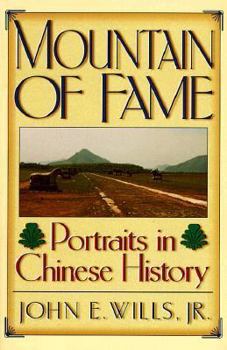
Mountain of Fame: Portraits in Chinese History

Select Format
Select Condition 
Book Overview
Through biographies of China's most colorful and famous personalities, John Wills displays the five-thousand-year sweep of Chinese history from the legendary sage emperors to the tragedy of Tiananmen Square. This unique introduction to Chinese history and culture uses more than twenty exemplary lives, including those of statesmen, philosophers, poets, and rulers, to provide the focus for accounts of key historical trends and periods. What emerges is a provocative rendering of China's moral landscape, featuring characters who have resonated in the historical imagination as examples of villainy, heroism, wisdom, spiritual vision, political guile, and complex combinations of all of these. Investigating both the legends and the facts surrounding these figures, Wills reveals the intense interest of the Chinese in the brilliance and in the frail complexities of their heroes. Included, for instance, is a description of the frustrations and anxieties of Confucius, who emerges as a vulnerable human being trying to restore the world to the virtue and order of the sage kings. Wills recounts and questions the wonderfully shocking stories about the seventh-century Empress Wu, an astute ruler and shaper of an increasingly centralized monarchy, who has since assumed a prominent position in the Chinese tradition's rich gallery of bad examples--because she was a woman meddling in politics. The portrayal of Mao Zedong, which touches upon this leader's earthy personality and his reckless political visions, demonstrates the tendency of the Chinese not to divorce ideology from its human context: Maoism for them is a form of "objective" Marxism, inseparable from one man's life and leadership. Each of the twenty chapters provides a many-sided exploration of a "slice" of Chinese history, engaging the general reader in a deep and personal encounter with China over the centuries and today. The biographies repeatedly mirror the moral earnestness of the Chinese, the great value they place on the ruler-minister relationship, and their struggles with tensions among practicality, moral idealism, and personal authenticity. Culminating in a reflection on China's historical direction in the aftermath of Tiananmen Square, the biographies show the modern Chinese still inspired and frustrated by a complex heritage of moral fervor and political habits and preconceptions. As absorbing as it is wide ranging, this history is written for the general public curious about China and for the student beginning to study its rich cultural heritage.
Format:Paperback
Language:English
ISBN:0691026742
ISBN13:9780691026749
Release Date:July 1996
Publisher:Princeton University Press
Length:424 Pages
Weight:1.35 lbs.
Dimensions:9.5" x 1.0" x 6.3"
Customer Reviews
2 ratings
Heroes and villains
Published by Thriftbooks.com User , 19 years ago
'It remains hard to imagine a short-term bearable future for the people of China,' wrote John Willis, who teaches history at Southern Cal, in 1994. He also said that a continuing theme of Chinese society has been 'optimism about what man can be and can accomplish.' It is certainly a portentous question, how a country with a thoughtful and ancient social philosophy of optimism can have attained the sorry state it is in now. Wills attempts to answer the question by looking at the lives of about 20 great Chinese, to understand what they thought they were doing and, also, what later Chinese thought about them. 'This book . . . is intended for people who never have paid much attention to China and now want a quick and graspable introduction to some main themes in its stirring history.' The development of Chinese political theory is far easier to grasp than the equally significant development of Chinese religion. Portraits of famous men (and one woman, the scandalous Empress Wu) are an appropriate way to enter Chinese mentality, says Wills, because the Chinese have been 'more inclined than most peoples to cast their moral and political principles and arguments in terms of individuals who are idolized or reviled.' Whether they really are more inclined to personalize their own history than other people is doubtful, but Wills makes a good case that the Chinese have placed more value on theory than on good practice. 'The drama was heightened, the selflesslness more perfect when nothing else was accomplished except to demonstrate one's firmness in principle in the face of futility, humiliation and death,' he writes. Many other societies have preferred to honor leaders who got things changed. Robin Hood, for example. but the great Chinese outlaw story, 'Water Margin,' does not have the happy ending (for the common folk) of the Robin Hood story, or William Tell or many another hero outside China. From earliest times -- that is, from the third emperor, Yu, the first subject of 'Mountain of Fame' -- the Chinese have systematized government, in sharp contrast to the helterskelter turmoil of, say, Europe following the German invasions. The result, says Wills, has been paradoxical. 'From Wang Mang to Deng Xiaoping, Chinese policymakers all too often have lacked Su's suspicion of uniformity and have made trouble for themselves and their people by trying to impose on all Chinese policies that make sense for some important part of it.' Su is Su Dongpo, a poet and politician of the 11th century, the earliest hero in 'Mountain of Fame' who is more history than myth. A mass of Su's essays, poems and state papers have survived. This is surprisingly late. For Europe, Sumeria, Egypt and India, we have much earlier famous men that we can think we understand. Whether we can understand the early Chinese luminaries or not, though, Wills believes we can understand what their myths mean today. The reason 'Mountain of Fame' is important is that China has too many people to ig
Walking on the Mountain of Fame
Published by Thriftbooks.com User , 25 years ago
Professor Willis has, in this fine book, made a substantial contribution to the knowledge of Chinese history for those who read in English. Mountain of Fame is an exciting overview of famous persons from China's prehistoric heroes to today's names in the news. The book consists of twenty chapters, most of them dedicated to an individual who embodies some essential aspect of their milieu much in the same tradition as Plutarch's Lives describes the historic noble Greeks and Romans. The penultimate and last chapters are dedicated to multiple persons and the flurry of events that has propelled China into a leading position in today's world news. This makes them of special interest to those seeking a broad overview on recent events in China. Wills' historical description at the beginning of each chapter offers a necessary context for understand the person he has chosen to discuss. I have used this book for enjoyment and as reference repeatedly since adding it to my collection. This book may not be the best place to start learning Chinese history. However, I think that if the reader has some interest in the subject and a little exposure to Chinese philosophy, language or history this book makes an invaluable addition to any ones library.
Copyright © 2026 Thriftbooks.com Terms of Use
| Privacy Policy | Do Not
Sell/Share My Personal Information | Cookie Policy | Cookie Preferences | Accessibility Statement
ThriftBooks® and the ThriftBooks® logo are registered trademarks of Thrift Books Global, LLC
ThriftBooks® and the ThriftBooks® logo are registered trademarks of Thrift Books Global, LLC
