
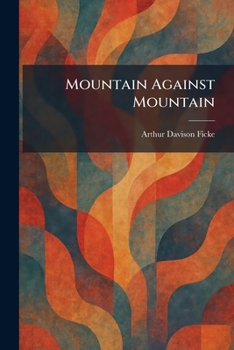
"Mountain Against Mountain" is a compelling collection of verse by the acclaimed American poet and playwright Arthur Davison Ficke. Published during a transformative period in modern literature, this work showcases Ficke's mastery of both form and emotion, offering readers a series of evocative poems that explore the depths of human experience. The collection is notable for its narrative strength and lyrical beauty, moving through themes of personal introspection, the natural world, and the complexities of human relationships.
Ficke, a prominent figure in early 20th-century poetry, employs a sophisticated style that bridges traditional craftsmanship with modern sensibilities. The volume includes powerful narrative sequences that delve into philosophical inquiries and historical echoes, capturing the spirit of an era marked by shifting cultural landscapes. From intimate lyrics to broader meditations on life and mortality, "Mountain Against Mountain" remains a significant contribution to the American poetic canon. This collection invites readers to engage with the profound observations and technical brilliance of a poet who was a contemporary of the great modernist thinkers. It is an essential volume for those interested in the evolution of American poetry and the enduring power of the written word.
This work has been selected by scholars as being culturally important, and is part of the knowledge base of civilization as we know it. This work was reproduced from the original artifact, and remains as true to the original work as possible. Therefore, you may see the original copyright references, library stamps (as most of these works have been housed in our most important libraries around the world), and other notations in the work.
This work is in the public domain in the United States of America, and possibly other nations. Within the United States, you may freely copy and distribute this work, as no entity (individual or corporate) has a copyright on the body of the work.
As a reproduction of a historical artifact, this work may contain missing or blurred pages, poor pictures, errant marks, etc. Scholars believe, and we concur, that this work is important enough to be preserved, reproduced, and made generally available to the public. We appreciate your support of the preservation process, and thank you for being an important part of keeping this knowledge alive and relevant.

