


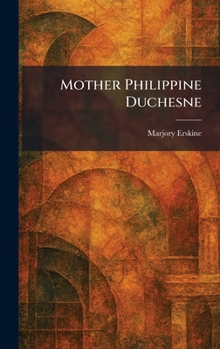
Mother Philippine Duchesne

"Mother Philippine Duchesne" is an insightful and detailed biography of Saint Rose Philippine Duchesne, a French religious sister who became a pivotal figure in the Catholic missionary history of the United States. The work follows her life from her upbringing in revolutionary France to her arrival on the American frontier in 1818, where she established the first houses of the Society of the Sacred Heart outside of Europe.
The narrative explores her tireless efforts to provide education and spiritual guidance in the rugged Missouri Territory, highlighting her role in founding the first free schools west of the Mississippi River. Marjory Erskine provides a deep look into Duchesne's profound spiritual life and her particular devotion to the Potawatomi people, who knew her as the "Woman Who Prays Always." This work serves as both a historical record of early 19th-century American life and an inspiring portrait of a woman whose resilience and faith shaped the educational and religious landscape of the Midwest. It offers a valuable perspective on the intersection of European religious traditions and the development of the American frontier.
This work has been selected by scholars as being culturally important, and is part of the knowledge base of civilization as we know it. This work was reproduced from the original artifact, and remains as true to the original work as possible. Therefore, you may see the original copyright references, library stamps (as most of these works have been housed in our most important libraries around the world), and other notations in the work.
This work is in the public domain in the United States of America, and possibly other nations. Within the United States, you may freely copy and distribute this work, as no entity (individual or corporate) has a copyright on the body of the work.
As a reproduction of a historical artifact, this work may contain missing or blurred pages, poor pictures, errant marks, etc. Scholars believe, and we concur, that this work is important enough to be preserved, reproduced, and made generally available to the public. We appreciate your support of the preservation process, and thank you for being an important part of keeping this knowledge alive and relevant.
Customer Reviews
ThriftBooks ® and the ThriftBooks ® logo are registered trademarks of Thrift Books Global, LLC
