


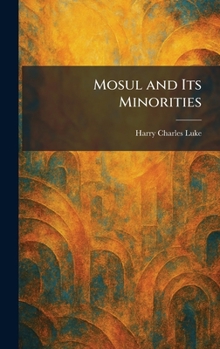
Mosul and Its Minorities

"Mosul and Its Minorities" is an insightful and detailed study of the diverse religious and ethnic landscape of Northern Iraq during the early twentieth century. Written by Harry Charles Luke, a seasoned traveler and colonial official, the work provides an in-depth exploration of the region often called the "cradle of civilizations" during a period of significant geopolitical transition. The book offers a unique and scholarly glimpse into the lives, traditions, and complex histories of several distinct communities, including the Yezidis, the Nestorian and Chaldean Christians, and the Mandaeans.
Luke's narrative combines rigorous historical research with firsthand personal observation, capturing the intricate social fabric of Mosul and its surrounding districts. From the sacred shrines of Sheikh Adi to the ancient monasteries of the Nineveh plains, the author documents the endurance of ancient faiths and customs in the face of a rapidly changing world. "Mosul and Its Minorities" serves as a valuable primary source for those interested in Middle Eastern history, comparative religion, and ethnographic heritage. This work remains a significant contribution to the understanding of the pluralistic identity of Iraq and the historical challenges faced by its minority populations during the post-Ottoman era.
This work has been selected by scholars as being culturally important, and is part of the knowledge base of civilization as we know it. This work was reproduced from the original artifact, and remains as true to the original work as possible. Therefore, you may see the original copyright references, library stamps (as most of these works have been housed in our most important libraries around the world), and other notations in the work.
This work is in the public domain in the United States of America, and possibly other nations. Within the United States, you may freely copy and distribute this work, as no entity (individual or corporate) has a copyright on the body of the work.
As a reproduction of a historical artifact, this work may contain missing or blurred pages, poor pictures, errant marks, etc. Scholars believe, and we concur, that this work is important enough to be preserved, reproduced, and made generally available to the public. We appreciate your support of the preservation process, and thank you for being an important part of keeping this knowledge alive and relevant.
Customer Reviews
ThriftBooks ® and the ThriftBooks ® logo are registered trademarks of Thrift Books Global, LLC
