
Skip to content
Scan a barcode
Scan
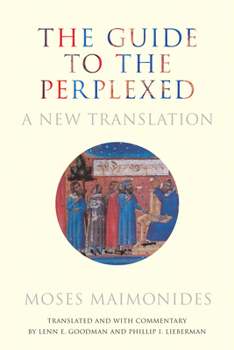
Paperback The Guide to the Perplexed: A New Translation Book

ISBN: 1503645916

ISBN13: 9781503645912

The Guide to the Perplexed: A New Translation

(Book #2 in the מורה הנבוכים Series)

Select Format

Select Condition ThriftBooks Help Icon

Recommended

Format: Paperback

Condition: New

$28.72
Save $1.28!
List Price $30.00
Ships within 24 hours
Save to List

Book Overview

A landmark new translation of the most significant text in medieval Jewish thought.

Written in Arabic and completed around 1190, the Guide to the Perplexed is among the most powerful and influential living texts in Jewish philosophy, a masterwork navigating the straits between religion and science, logic and revelation. The author, Rabbi Moses ben Maimon, commonly known as Maimonides or as Rambam, was a Sephardi Jewish philosopher, jurist, and physician. He wrote his Guide in the form of a letter to a disciple. But the perplexity it aimed to cure might strike anyone who sought to square logic, mathematics, and the sciences with biblical and rabbinic traditions. In this new translation by philosopher Lenn E. Goodman and historian Phillip I. Lieberman, Maimonides' warm, conversational voice and clear explanatory language come through as never before in English.

Maimonides knew well the challenges facing serious inquirers at the confluence of the two great streams of thought and learning that Arabic writers labeled 'aql and naql, reason and tradition. The aim of the Guide, he wrote, is to probe the mysteries of physics and metaphysics. But mysteries, to Maimonides, were not conundrums to be celebrated for their obscurity. They were problems to be solved.

Maimonides' methods and insights resonate throughout the work of later Jewish thinkers, rationalists, and mystics, and in the work of philosophers like Thomas Aquinas, Spinoza, Leibniz, and Newton. The Guide continues to inspire inquiry, discovery, and vigorous debate among philosophers, theologians, and lay readers today. Goodman and Lieberman's extensive and detailed commentary provides readers with historical context and philosophical enlightenment, giving generous access to the nuances, complexities, and profundities of what is widely agreed to be the most significant textual monument of medieval Jewish thought, a work that still offers a key to those who hope to harmonize religious commitments and scientific understanding.

Customer Reviews

4 ratings

A must for anyone interested in religion and/or Judaism

This has become one of my favourite non-fiction books. The Rambam (Maimonides) is an absolute giant of learning and explanations. In this volume, he presents many of the philosophical sides of Judaism which are rarely encountered.The text is divided into 3 books.The first book starts with discussing the use of homonyms in the Bible, especially in relation to describing God. The thesis that emerges is that it is only superficially that the Bible describes God as corporeal but the real doctrine precludes corporeality. The second topic discussed is the nature of esoteric study in Judaism and why it should only be taught in a restricted manner. The third topic is where Rambam protests against people using positive attributes to describe God and tries to prove that God is beyond such attributes. Then, he describes the Kalam argument (an Islamic school of thought that tried to prove the existence of God amongst other things) and points out his view of the flaws in it.The second book starts with a discussion of Aristotelian philosophy in terms of cosmology and metaphysics and compares that with Judaism, especially the mystical tradition. Rambam then gives his own view of the world structure which is at times very amusing in terms of what we know of science but still very interesting. Then, he describes the nature of prophecy and what exactly it meant to be a Biblical prophet.The third book opens with a hinted exposition of mystical passages in the Bible, such as Ezekiel's Chariot (Ezek Chap 1 and others). Then, he talks about God and the problem of Evil as well as providence. Finally, he describes the perfect worship of God as well as the purpose of most of the major commandments in the Torah. It is here that I could see why there was much opposition to the work from within the Jewish community - as he tends to provide unorthodox rationalisations that go against traditional expositions.As you cna see, he convers sooooo much that a serious believer or non-believer would wish to consider that it's an absolute gem. The translation is dense, both in language and print but at least it's accessible in terms of being in one volume as well as the price. If you can penetrate the at-times-archaic language, I think this book will greatly enrich your life.

Best translation of an essential work

This is volume one of a two volume set, so be sure to get both volumes. Volume one contains two interpretive essays, one by Leo Strauss and one by the translator, the former alone making this translation worthy of purchase, according to the Times Literary Supplement. Maimonides' work itself is an intentionally tangled web of reason, and casual readers will likely leave disappointed with its obscure style. Maimonides assumes a great deal of Scriptural knowledge and a familiarity with the most important commentators of his time. Nevertheless, for those willing to put in the effort both in learning the fundamentals of religion and in exploring an almost endless maze of logic, Maimonides will sketch the outlines of his view of philosophy and faith.

Unsurpassed translation of an unsurpassed classic

No one can deny that the Guide is the most important single work in the history of Jewish philosophy. Until this translation appeared it was available either in the original Arabic, a medieval Hebrew translation (difficult even for native Hebrew speakers) or in an unacceptable English translation (Friedlander). This translation is wonderful and if at times it is difficult it is because it tries to copy the ambiguities of the original. The only thing I could say against the edition is that the introductions of Pines (somewhat) and Strauss (totally) are idiosyncratic and not so helpful for the reader who does not share their views on Maimonides/

The Best Translation Available of an Arabic Masterpiece

There is no translation of Maimonides' Guide which compares to this, and, although Pines is known to side more with the Strausian school, his views are rarely if at all worked into this translation. For Maimonidian studies, this is a must buy.
Copyright © 2026 Thriftbooks.com Terms of Use | Privacy Policy | Do Not Sell/Share My Personal Information | Cookie Policy | Cookie Preferences | Accessibility Statement
ThriftBooks ® and the ThriftBooks ® logo are registered trademarks of Thrift Books Global, LLC

GoDaddy Verified and Secured