


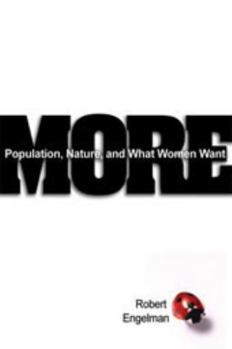
More: Population, Nature, and What Women Want

Select Format
Select Condition 
Book Overview
In the capital of Ghana, a teenager nicknamed "Condom Sister" trolls the streets to educate other young people about contraception. Her work and her own aspirations point to a remarkable shift not... This description may be from another edition of this product.
Format:Hardcover
Language:English
ISBN:1597260193
ISBN13:9781597260190
Release Date:May 2008
Publisher:Island Press
Length:303 Pages
Weight:1.30 lbs.
Dimensions:1.0" x 6.3" x 9.3"
Customer Reviews
5 ratings
An important book for today's world
Published by Thriftbooks.com User , 16 years ago
Probably the most important book I have read this year. His solution to overpopulation is rather simple and only really involves giving women their basic human rights. The solution basically boils down to simply giving women power over their own bodies, and the right to choose what is best for themselves. What the author shows the reader is that when women are allowed to control their own reproduction then they make choices that are not only best for themselves, but also what is best for their families and in the end for their communities as well. This makes the author's position very easy to defend because even if you don't believe the world suffers from overpopulation it doesn't matter because the author is saying that women should decide what is right for themselves. If you don't agree with his basic premise it is still very hard to try and assail his solution. The author does an excellent job detailing the history of sex as well. The author puts forward a lot of ideas that at the very least will make the reader think. His discussion on the history of birth control was fascinating. I did not realize that so much had come before modern methods. What this history shows in the end is the importance of giving women (and men) options. Whether you agree with the author or not, his book is a very interesting and entertaining read. While a lot of it is heavy lifting, the author adds some comical asides every now and then to lighten the load. I think this is a very important read. The history is fascinating and the author's own experience adds a tremendous amount of perspective to this very important topic. You need to read this book.
Lessons from Robert Engelman's More: Population, Nature, and What Women Want (Island Press, 2008)
Published by Thriftbooks.com User , 17 years ago
Only in the last few years has the environmentalist community's urgent warning of the perils of human-induced global warming begun to be reported seriously by the mainstream American media and to have a significant impact on public discourse and policy. Although still inadequate to the need, this discourse far exceeds the meager attention currently given in the public sphere to the root cause of global warming -- excessive population, both human and animal -- and the environmental, economic and social consequences of population growth. A recently published book, More: Population, Nature, and What Women Want, by longtime population analyst and activist Robert Engelman, does much to fill this void with the big picture it conveys. Engelman's principal goal is to show how human numbers have grown to the point of unsustainability and to suggest the most effective way to curb their further increase in the hope of preventing the ultimate danger they pose--our extinction. This highly readable book merits widespread circulation and careful consideration not only by politicians, policy makers, and members of the media, but also by the general public, especially young people, who will need far more wisdom and understanding in dealing with the looming crises facing humankind and the natural world than their parents and grandparents have exhibited. It would make an ideal book to challenge and stimulate college students through the important perspective it gives on the past and the insights it contains for the present. In what follows, I have highlighted concepts, concerns, themes, paradigms, facts, and historical perspectives in Engelman's work that I find particularly noteworthy and compelling for an appreciation of the intimate connections and interactions of human gender, reproduction, numbers, and environmental stress that form the main focus of the book. In doing this, I have liberally paraphrased and quoted the author's carefully chosen words, knowing that I cannot do better. I hope this extract will whet the reader's appetite for the real thing, or for those who may read nothing else, at least help convey the importance of population in our lives, and encourage active interest and participation in the vital issues with which Engelman so eloquently deals. [...]
An important read
Published by Thriftbooks.com User , 17 years ago
This was a very enlightening read for me. The author does a really good job of making his case for family planning and the necessity of making sure that women have control and plenty of choices over their bodies and reproduction. This book really details the problems with population rise, and gives a pretty good historical account of why population stability is so important. This is an important book that needs to be read. The author offers the reader a pretty good thumbnail sketch of the theories of where we Homo Sapiens originally came from, and why it was that we ended up on top rather than some of our distant cousins. Many of these theories are subjective and in the field of evolutionary biology there are as many theories as there are really good scholars, pretty good scholars, amateurs and your run of the mill crackpot, so for the number of pages the author does a really nice job giving the reader a good sampling of theories without overloading the reader. Next the author gives the reader a very interesting history of contraceptives, attitudes towards sex over human history, feminism and opposition to all of these. I was fascinated to learn parts of history I was completely ignorant about before reading this book. The author also posits some very interesting theories about humans move to agrarian societies all the way to the witch trials in Europe. The author makes a very strong argument for sex and population being very important prime movers in human events. Of course population size and sex are always important, but this book has put forth some ideas I had not considered before. What was very compelling for me was the author's work and description of working in third world countries. Reading his interviews with these people and getting an idea of the desperation they live with and the problems they face because they do not have access to adequate contraceptives or education was distressing. I couldn't imagine a life spent either pregnant or taking care of an infant all of ones life, or having sex be similar to playing Russian roulette where every encounter could cause pregnancy or disease. Even more than that was how badly these people want access to contraceptives and family planning resources which is heartbreaking. As I was reading about all the deaths and disease attributable to abortions and births performed in unsafe conditions that could have been prevented with nothing more than a simple condom you realize how lucky we are and just how little it would take to change other peoples lives for the better. This book has some very well thought out arguments with detailed conclusions backed up with historical data and first hand research. Not only that but the author presents the material in a very accessible way. The book is short which diminishes the intimidation factor, and will hopefully make it more palatable for a more general readership. My one main criticism is that I hate the silly little puns and some of the
Trusting women and respecting history
Published by Thriftbooks.com User , 17 years ago
Finally, a book about population and family planning that those of us who work on population issues can distribute proudly to those who aren't in the field! Engelman outlines the history of women managing their fertility through the ages, from our humble beginnings as homo erectus through modern day. Throughout human history some women have prevented conception with herbs and pessaries. And some women have always backed up these methods with abortion and infanticide. His point is that women's desire to have small families is not new and that modern contraception should be available to any woman who wants it, in order to avoid the crude methods that our ancestors were stuck with. Engelman writes about women with great respect and humorously describes why men and women so often differ on their ideas about ideal childbearing (both timing and total number). In fact, humor is an integral part of this book. Engelman was a journalist in a past life and his catchy, accessible writing style shines through on every page. I highly recommend this book to anyone who wants to learn more about demography, women's reproductive rights, and/or anthropology. This book should interest just about anyone and is not the dry, academic sort of textbook that you might expect of this topic. I'm even going to propose it as a selection for my monthly book club!
"More" is Needed
Published by Thriftbooks.com User , 17 years ago
It seems inevitable that the world food crisis, combined with climate change and rising energy prices, will spur a renewed and contentious debate over the issue of population. Before that debate is renewed in its full intensity, everyone should read this book. What the author gives us, and what is so desperately need at this critical juncture in the debate over population, is historical perspective. His book, in fact, takes up back to our ancestral roots to give us a better understanding of such things as human reproduction, the centuries' old debate over population, and efforts by governments to "control" population by encouraging human procreation or restricting it. Many people today believe that birth control is a thoroughly modern invention, but as Engelman observes in his book, women throughout history have sought to control their fertility, as well as enhance it. In response to shrinking resources or deteriorating conditions, women have often sought--though not always successfully--to space or limit their pregnancies. Engelman takes what he calls a "Zen' approach to population. He argues that the best way to "control" population is to give up control, by giving women the power to decide for themselves when to bear a child. He notes that many women in the world still lack access to modern contraceptive methods and that, if given that access, fertility rates will likely decline further. Giving girls the education they need and the equality they deserve, he argues, would also result in lower fertility rates. At the same time, he voices the conviction that concerns about an eventual population implosion are overblown. As the planet gets less crowded, he believes that women will want more children, enough at least to keep fertility rates at or near the "replacement rate" needed to stabilize population. Engelman makes clear, however, that world population may already be, or may soon be, unsustainable. He stops well short of making a Malthusian prediction about impending famine, but he says, "...it's getting hard to be confident that fishers and farmers will easily feed the 9.2 billion people projected to be alive in 2050." In the last chapter, he notes that people in developing countries dream of acquiring the necessities that we take for granted. "But what happens," he asks, "when the dreams of people everywhere become unsustainable--not because of the nature of the dreams, but because the numbers of the dreamers?" If you concerned about global population or just interested in learning more about the topic and the debate that swirls around it, this is an entertaining, informative and compelling book. I highly recommend it.
Copyright © 2026 Thriftbooks.com Terms of Use
| Privacy Policy | Do Not
Sell/Share My Personal Information | Cookie Policy | Cookie Preferences | Accessibility Statement
ThriftBooks® and the ThriftBooks® logo are registered trademarks of Thrift Books Global, LLC
ThriftBooks® and the ThriftBooks® logo are registered trademarks of Thrift Books Global, LLC
