


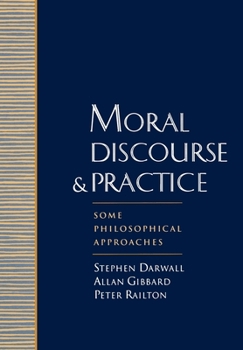
Moral Discourse and Practice: Some Philosophical Approaches

Select Format
Select Condition 
Book Overview
What are ethical judgments about? And what is their relation to practice? How can ethical judgment aspire to objectivity? The past two decades have witnessed a resurgence of interest in metaethics, placing questions such as these about the nature and status of ethical judgment at the very center of contemporary moral philosophy.
Moral Discourse and Practice: Some Philosophical Approaches is a unique anthology which collects important recent work, much of which is not easily available elsewhere, on core metaethical issues. Naturalist moral realism, once devastated by the charge of "naturalistic fallacy," has been reinvigorated, as have versions of moral realism that insist on the discontinuity between ethics and science. Irrealist, expressivist programs have also developed with great subtlety, encouraging the thought that a noncognivist account may actually be able to explain ethical judgments' aspirations to objectivity. Neo-Kantian constructivist theories have flourished as well, offering hope that morality can be grounded in a plausible conception of reasonable conduct. Together, the positions advanced in the essays collected here address these recent developments, constituting a rich array of approaches to contemporary moral philosophy's most fundamental debates. An extensive introduction by Darwall, Gibbard, and Railton is also included, making this volume the most comprehensive and up-to-date work of its kind. Moral Discourse is ideally suited for use in courses in contemporary ethics, ethical theory, and metaethics.
Moral Discourse and Practice: Some Philosophical Approaches is a unique anthology which collects important recent work, much of which is not easily available elsewhere, on core metaethical issues. Naturalist moral realism, once devastated by the charge of "naturalistic fallacy," has been reinvigorated, as have versions of moral realism that insist on the discontinuity between ethics and science. Irrealist, expressivist programs have also developed with great subtlety, encouraging the thought that a noncognivist account may actually be able to explain ethical judgments' aspirations to objectivity. Neo-Kantian constructivist theories have flourished as well, offering hope that morality can be grounded in a plausible conception of reasonable conduct. Together, the positions advanced in the essays collected here address these recent developments, constituting a rich array of approaches to contemporary moral philosophy's most fundamental debates. An extensive introduction by Darwall, Gibbard, and Railton is also included, making this volume the most comprehensive and up-to-date work of its kind. Moral Discourse is ideally suited for use in courses in contemporary ethics, ethical theory, and metaethics.
Format:Paperback
Language:English
ISBN:019509669X
ISBN13:9780195096699
Release Date:September 1996
Publisher:Oxford University Press
Length:432 Pages
Weight:1.45 lbs.
Dimensions:1.2" x 6.5" x 9.2"
Customer Reviews
1 rating
First-Rate Anthology of Contemporary Meta-Ethics
Published by Thriftbooks.com User , 22 years ago
This volume--edited by Darwall, Gibbard, and Railton (hereafter "DGR")--may be the best anthology for the reader looking to survey contemporary meta-ethics. One strength of this anthology is its breadth. It covers influential work concerning apparent problems for the objectivity of morality; responses to these problems provided by realists, noncognitivists, sensibility theorists, and constructivists; and, unlike many anthologies covering meta-ethics, it includes a section devoted the practical dimension of morality. Another strength is the quality of the work represented here. Nearly every paper included is a contemporary classic that should be read by everyone interested in meta-ethics. Finally, the paper includes a top-notch introduction to the issues. The anthology opens with that introduction--DGR's "Toward Fin de siecle Ethics: Some Trends," which originally appeared in the centennial edition of the Philosophical Review. This long paper, published in 1993 and intended to give readers an overview of the then-current state of debate in meta-ethics, is an excellent introduction to the issues covered in the anthology. Indeed, the rest of the volume is built around this paper. The paper opens with a very helpful, albeit short, introduction to the history of meta-ethics in the twentieth century. G. E. Moore's Open Question Argument sets the process of twentieth-century meta-ethics in motion; noncognitivism appears as a response to the perceived inadequacies of Moorean realist intuitionism; and the various contemporary views in meta-ethics arise in response to a renewed interest in normative ethics in the last quarter of the twentieth century. Following this historical introduction, the majority of the paper is devoted to the contemporary scene in meta-ethics. It includes brief sketches of the basic ideas of most of the competitors available: reductive naturalistic realism, non-reductive naturalistic realism, Foot's neo-Aristotelianism, practical reasoning theories, noncognitivism, constructivism, and sensibility theories. DGR don't go into detail about all these competitors, but their paper provides a useful taxonomy of views and a sense of their relations to one another. The first part of the anthology covers certain putative problems with understanding morality as objective. In particular, the focus is on the relation between facts and values. The section opens with the sections from Moore's Principia Ethica in which he develops the OQA; this selection, it seems, is presented as a way to draw out our intuitions about a fact/value gap. Moore wants to retain the view that value claims are factual, though they're a very special sort of fact. Wittgenstein, in the next paper, develops his intuitions about the fact/value gap in a direction that moves him closer to the view that value judgments aren't really factual judgments at all. Then we see these intuitions about the relations between facts and values taken up and transformed
Copyright © 2026 Thriftbooks.com
Terms of Use | Privacy Policy | Do Not Sell/Share My Personal Information | Cookie Policy | Cookie Preferences | Accessibility Statement
ThriftBooks ® and the ThriftBooks ® logo are registered trademarks of Thrift Books Global, LLC
ThriftBooks ® and the ThriftBooks ® logo are registered trademarks of Thrift Books Global, LLC
