


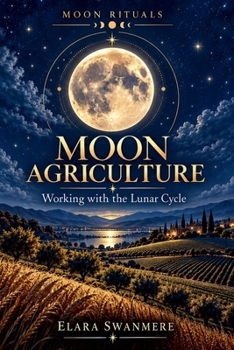
Moon Agriculture

The Moon has been used to time farm work for generations-but lunar agriculture is far more complex than planting by the waxing Moon and harvesting by the waning Moon.
Moon Agriculture is a comprehensive practical guide to working with lunar timing across the full agricultural year. Rather than reducing the subject to a four-phase chart, Elara Swanmere examines the many lunar clocks preserved in historical and living farming traditions: lunar days, waxing and waning phases, new and full Moon, ascending and descending Moon, strong and weak Moon, crop-part days, nodes, perigee and apogee, tides, planetary relationships, and specialized agricultural calendars.
The book follows the farm from the ground up. It explores lunar timing for land preparation, manure and compost, irrigation, seed selection, sowing, transplanting, cuttings and grafts, weed control, pruning, harvest, drying, storage, wine and processing, pasture, hay and silage, livestock breeding and birth, weaning, poultry, bees, dairy work, trees, timber, bamboo and rural fibers, construction materials, sap and resin, mixed cropping, agroforestry, coastal agriculture, vineyards, biodynamic timing, and whole-farm planning.
Throughout the book, lunar timing remains grounded in agricultural reality. A favorable Moon does not override unsafe weather, immature crops, unsuitable soil, animal welfare, food safety, or the biological readiness of plants and animals. When traditions disagree, their differences are preserved rather than blended into invented universal rules.
The final chapters show how to combine multiple agricultural operations into a workable lunar calendar without forcing every task into the same phase.
For growers, homesteaders, gardeners, small farmers, and readers interested in traditional lunar agriculture, this book offers a detailed framework for understanding not simply which Moon to choose-but which lunar system belongs to the work being done.
Customer Reviews
ThriftBooks ® and the ThriftBooks ® logo are registered trademarks of Thrift Books Global, LLC
