


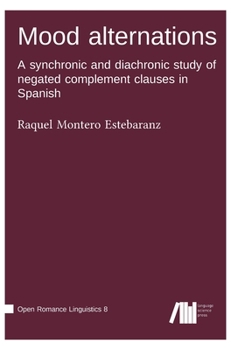
Mood alternations: A synchronic and diachronic study of negated complement clauses in Spanish
No Customer Reviews

This book investigates Polarity Mood (PM) in Peninsular Spanish and how the phenomenon has evolved diachronically. In particular, it explores from a theoretical and empirical perspective the interaction of PM with five other linguistic phenomena: (i) the verb class of the matrix predicate, (ii) the presence of a first-person subject; (iii) the type of matrix clause, (iv) information structure, and (v) the presence of Negative Polarity Items. Drawing inspiration from the competing grammars framework, the book starts by proposing an account of mood morphology in terms of three competing systems: one in which mood morphology is used as a hedging device to express the degree of commitment; another in which mood is analyzed as a pronoun which indicates that the world of evaluation lies in some accessible Context Set; and another in which mood is used as a purely grammaticalized syntactic marker. The second part of the book shows how the historical competition between these systems explains the diachronic development observed in corpus data, as well as the present-day mood selection patterns.
Format:Hardcover
Language:English
ISBN:3985541868
ISBN13:9783985541867
Release Date:March 2026
Publisher:Language Science Press
Length:264 Pages
Weight:1.37 lbs.
Dimensions:0.6" x 6.7" x 9.6"
Related Subjects
Language ArtsCustomer Reviews
0 rating
Copyright © 2026 Thriftbooks.com
Terms of Use | Privacy Policy | Do Not Sell/Share My Personal Information | Cookie Policy | Cookie Preferences | Accessibility Statement
ThriftBooks ® and the ThriftBooks ® logo are registered trademarks of Thrift Books Global, LLC
ThriftBooks ® and the ThriftBooks ® logo are registered trademarks of Thrift Books Global, LLC
