


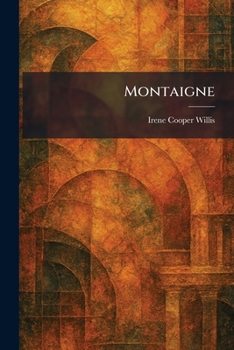
Montaigne

Select Format
Select Condition 
Book Overview
"Montaigne" by Irene Cooper Willis offers a compelling and insightful exploration into the life and mind of one of the most influential figures of the French Renaissance. Michel de Montaigne, the father of the modern essay, is presented here not just as a historical figure, but as a living intellect whose skepticism and profound humanism continue to resonate today. Willis meticulously traces the development of Montaigne's thought, examining how his experiences and reflections culminated in his seminal "Essays."
The work delves into the quiet retirement of the nobleman in his tower, where he embarked on a journey of self-discovery that would redefine the boundaries of literature and philosophy. By focusing on his character, his relationships, and his unique literary style, Willis provides readers with a lucid analysis of Montaigne's pursuit of truth and his insistence on the complexity of the human condition. This biography serves as an essential guide for those seeking to understand the origins of the personal essay and the enduring legacy of a man who taught the world how to look inward. It is a masterful tribute to the intellectual independence and timeless wisdom of a philosopher who remains a cornerstone of Western thought.
This work has been selected by scholars as being culturally important, and is part of the knowledge base of civilization as we know it. This work was reproduced from the original artifact, and remains as true to the original work as possible. Therefore, you may see the original copyright references, library stamps (as most of these works have been housed in our most important libraries around the world), and other notations in the work.
This work is in the public domain in the United States of America, and possibly other nations. Within the United States, you may freely copy and distribute this work, as no entity (individual or corporate) has a copyright on the body of the work.
As a reproduction of a historical artifact, this work may contain missing or blurred pages, poor pictures, errant marks, etc. Scholars believe, and we concur, that this work is important enough to be preserved, reproduced, and made generally available to the public. We appreciate your support of the preservation process, and thank you for being an important part of keeping this knowledge alive and relevant.
Customer Reviews
ThriftBooks ® and the ThriftBooks ® logo are registered trademarks of Thrift Books Global, LLC
