


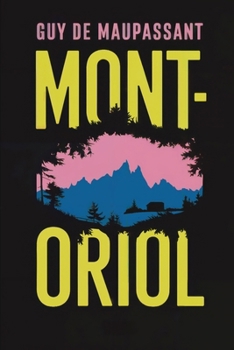
Mont-Oriol: A New Translation


Select Format
Select Condition 
Book Overview
A banker sees mineral springs. A young woman sees freedom. A man recovering from one love affair finds himself in another. And a peasant who has spent his life being underestimated by people who should know better watches them all and waits.
Mont-Oriol is Guy de Maupassant's third novel, published in 1887 after serialization in the newspaper Gil Blas, and it is one of his most fully achieved. Set in the thermal spa country of Auvergne - modeled on Ch tel-Guyon, where Maupassant himself took cures in the 1880s - the novel follows the convergence of a love affair and a business scheme in the volcanic landscape of central France, where ancient springs and cheap land have caught the attention of Parisian capital.
Christiane Andermatt has come to Enval with her husband William - a banker who processes everything through financial categories, including his wife - in hopes that the thermal baths will cure her presumed sterility. Her brother Gontran has come because he is always somewhere, doing nothing, spending money he doesn't have. Paul Br tigny has come to recover from one disappointment and finds another waiting for him, in a form he doesn't recognize until it's too late. And Father Oriol, the canny local peasant on whose land a spring happens to erupt, is about to become considerably richer and considerably more interesting to everybody.
The love story and the business story are inseparable, which is Maupassant's point. The Auvergne landscape - its gorges and volcanic hillsides and particular quality of summer light - creates the conditions for the affair between Christiane and Paul; Paris, and the return to ordinary life, will end it. Andermatt's scheme to build a rival spa gathers momentum alongside the affair, their parallel development one of the novel's organizing ironies. The doctors who certify the new spring's medicinal properties, the negotiations between Andermatt and the sharp-eyed Oriol, the charity lottery, the founding ceremony with its three springs named for a banker's wife and a peasant's daughters: all of it is observed with the cool, affectionate savagery that was Maupassant's greatest gift.
He was thirty-seven when he wrote this novel. He had less than five years of productive writing left, and he seemed to know it. Mont-Oriol is the work of a writer fully in command of the form he had mastered - precise, unsentimental, and, beneath its social comedy, quietly devastating.
Related Subjects
Fiction History Literary Literary Criticism & Collections Literature Literature & FictionCustomer Reviews
Plus ça change...
A good satire
ThriftBooks ® and the ThriftBooks ® logo are registered trademarks of Thrift Books Global, LLC
