


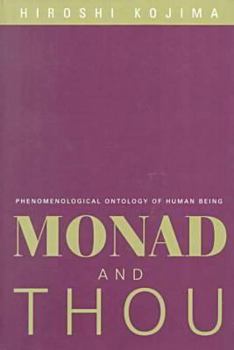
Monad and Thou: Phenomenological Ontology of Human Being Volume 27


The genesis for this volume was in the bombing of Japan during World War II, where the author, as a young boy, watched the bombers overhead, speculating about the lives of the pilots and their relationship with those huddled on the ground. From this disturbing diorama, Professor Hiroshi Kojima, the translator of Martin Buber into Japanese, unfolds a new approach to Buber's "I-Thou" relation, drawing upon insights from Husserl, Heidegger, and others in the tradition of continental philosophy to extend and deepen Buber's thought. In chapters that reflect upon a wide range of phenomena--from religion, science, and technology, to imagination, embodiment, and power--Professor Kojima articulates a conception of what it means to be a human being that stands as an alternative to atomism and alienation of the modern world. Analyses of haiku and other aspects of Japanese culture demonstrate how Kojima's theory can illuminate the spiritual traditions of both East and West. Original in its thought and revealing in its insight into Japanese thought and culture, Monad and Thou represents the life's work of one of Japan's great thinkers.
Format:Hardcover
Language:English
ISBN:0821413201
ISBN13:9780821413203
Release Date:May 2000
Publisher:Ohio University Press
Length:256 Pages
Weight:1.25 lbs.
Dimensions:0.9" x 6.3" x 9.4"
Related Subjects
PhilosophyCustomer Reviews
1 rating
Author's Review
Published by Thriftbooks.com User , 24 years ago
When one reflects upon the whole history of the philosophical investigation of the image of human being in the 20th century, three gigantic figures of seekers are visible whose pioneering steps still remain as something never passing away. One of them is called Edmund Husserl(1859-!938), founder of Phenomenology. He started from the analysis of human consciousness in general and reached the transcendental ego constituting the whole world as its intentional objects. Another of them is called Martin Heidegger (1889-1976),founder of the Existential Philosophy, who was the assistant of Husserl, but was not content with his Phenomenology and discovered the method to treat a human not as consciousness, but as a Being. The images of human described by Husserl and Heidegger are not identical, often contrasting, sometimes even contrary. Because Husserl seeks a human as an example of eternal ratio, while Heidegger seeks a human as a pure individuality. The author of this book learned much from both of them and founnd the very contact point of both images in the structure of human body as Leib-Koerper, or in the Being of his body seen from inside and from outside. In order to envisage the synthesis of such double subjectivities as working at this contact point (body), the Dialogical Thought of the third great figure called Martin Buber (1878-1965) was very helpful for the author.Here the new aspect of the second person dimension for the image of human is revealed by the author.
Copyright © 2026 Thriftbooks.com Terms of Use
| Privacy Policy | Do Not
Sell/Share My Personal Information | Cookie Policy | Cookie Preferences | Accessibility Statement
ThriftBooks® and the ThriftBooks® logo are registered trademarks of Thrift Books Global, LLC
ThriftBooks® and the ThriftBooks® logo are registered trademarks of Thrift Books Global, LLC
