


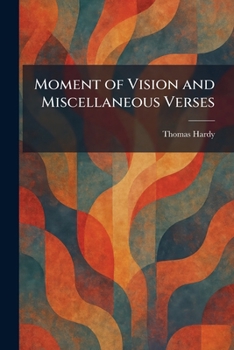
Moment of Vision and Miscellaneous Verses

Select Format
Select Condition 
Book Overview
"Moment of Vision and Miscellaneous Verses" is a profound collection of poetry by the celebrated author Thomas Hardy. Primarily composed of lyrics that explore the depths of human emotion and the relentless passage of time, this work showcases Hardy's unique transition from Victorian sensibilities toward a more modernist aesthetic. The collection is particularly notable for its exploration of memory, the haunting influence of the past, and the stark realities of life during the early 20th century.
Through his signature rhythmic precision and keen observation of the natural world, Hardy delves into the intricacies of fate and the inherent ironies of human existence. The poems within "Moment of Vision and Miscellaneous Verses" range from intimate reflections on personal loss to broader meditations on the social and spiritual shifts of his era. This volume remains a cornerstone of English literature, capturing the visionary spirit of a writer who considered poetry his truest calling. Readers will find in these verses a timeless exploration of the human condition, rendered with the sensitivity and intellectual rigor that define Hardy's enduring literary legacy.
This work has been selected by scholars as being culturally important, and is part of the knowledge base of civilization as we know it. This work was reproduced from the original artifact, and remains as true to the original work as possible. Therefore, you may see the original copyright references, library stamps (as most of these works have been housed in our most important libraries around the world), and other notations in the work.
This work is in the public domain in the United States of America, and possibly other nations. Within the United States, you may freely copy and distribute this work, as no entity (individual or corporate) has a copyright on the body of the work.
As a reproduction of a historical artifact, this work may contain missing or blurred pages, poor pictures, errant marks, etc. Scholars believe, and we concur, that this work is important enough to be preserved, reproduced, and made generally available to the public. We appreciate your support of the preservation process, and thank you for being an important part of keeping this knowledge alive and relevant.
Related Subjects
PoetryCustomer Reviews
ThriftBooks ® and the ThriftBooks ® logo are registered trademarks of Thrift Books Global, LLC
