


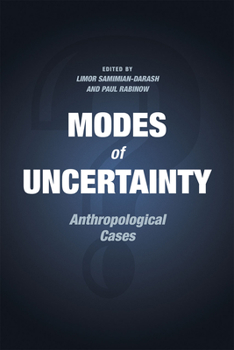
Modes of Uncertainty: Anthropological Cases
No Customer Reviews

Select Format
Select Condition 
Book Overview
Modes of Uncertainty offers groundbreaking ways of thinking about danger, risk, and uncertainty from an analytical and anthropological perspective. Our world, the contributors show, is increasingly populated by forms, practices, and events whose uncertainty cannot be reduced to risk--and thus it is vital to distinguish between the two. Drawing the lines between them, they argue that the study of uncertainty should not focus solely on the appearance of new risks and dangers--which no doubt abound--but also on how uncertainty itself should be defined, and what the implications might be for policy and government. Organizing contributions from various anthropological subfields--including economics, business, security, humanitarianism, health, and environment--Limor Samimian-Darash and Paul Rabinow offer new tools with which to consider uncertainty, its management, and the differing modes of subjectivity appropriate to it. Taking up policies and experiences as objects of research and analysis, the essays here seek a rigorous inquiry into a sound conceptualization of uncertainty in order to better confront contemporary problems. Ultimately, they open the way for a participatory anthropology that asks crucial questions about our contemporary state.
Format:Paperback
Language:English
ISBN:022625710X
ISBN13:9780226257105
Release Date:July 2015
Publisher:University of Chicago Press
Length:256 Pages
Weight:0.75 lbs.
Dimensions:0.6" x 6.0" x 8.9"
Customer Reviews
0 rating
Copyright © 2026 Thriftbooks.com Terms of Use
| Privacy Policy | Do Not
Sell/Share My Personal Information | Cookie Policy | Cookie Preferences | Accessibility Statement
ThriftBooks® and the ThriftBooks® logo are registered trademarks of Thrift Books Global, LLC
ThriftBooks® and the ThriftBooks® logo are registered trademarks of Thrift Books Global, LLC
