


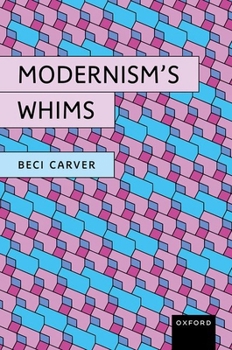
Modernism's Whims
No Customer Reviews

Thomas Hardy asks of the ghost stalking him: 'Whither, O whither will your whim now draw me?' Immediately tripping up on its own laid-out comma, then pausing to howl theatrically, and hedging its bets with a stuttering, archaic 'whither' that sceptically hovers between 'where' and 'whether', this line has already begun to worry about where it is going or being 'whim-drawn.' On the other hand, it enjoys its worry, over-performs the conundrum. It is a whim addressing a whim. Beci Carver's Modernism's Whims is a book about whims; their tyrannies, arbitrariness, ultimate frivolity: how they may feel urgent for all their lightness, while still letting you play, letting you go, letting you off the hook. The book is at once a meditation on the whim as a phenomenon and an endeavour to track the specific (albeit necessarily intangible) literary whims of four modernist writers: Hardy, T. S. Eliot, William Empson, Elsie Elizabeth Phare. Moving counter to the otherwise professionalised spirit of modernism, these literary whims and their author sponsors are imagined to occupy a fugitive position within the broader movement, their progress dangerously silly. Carver situates modernism after whim's Golden Age in the mid-nineteenth century, at a literary-historical moment when authors were expected to know what they were about. Hardy's stalker ghost is on the run.
Format:Hardcover
Language:English
ISBN:0198950721
ISBN13:9780198950721
Release Date:March 2026
Publisher:Oxford University Press
Length:198 Pages
Weight:1.00 lbs.
Dimensions:0.5" x 6.1" x 9.2"
Customer Reviews
0 rating
Copyright © 2026 Thriftbooks.com
Terms of Use | Privacy Policy | Do Not Sell/Share My Personal Information | Cookie Notice | Cookie Preferences | Accessibility Statement
ThriftBooks ® and the ThriftBooks ® logo are registered trademarks of Thrift Books Global, LLC
ThriftBooks ® and the ThriftBooks ® logo are registered trademarks of Thrift Books Global, LLC
