
Skip to content
Scan a barcode
Scan
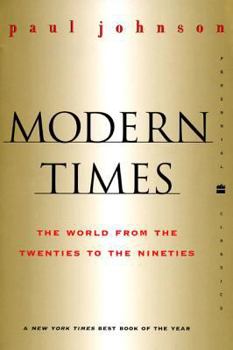
Paperback Modern Times Revised Edition: World from the Twenties to the Nineties, the Book

ISBN: 0060935502

ISBN13: 9780060935504

Modern Times Revised Edition: World from the Twenties to the Nineties, the

Select Format

Select Condition ThriftBooks Help Icon

Recommended

Format: Paperback

Condition: Very Good*

*Best Available: (ex-library)

$8.09
Save $15.90!
List Price $23.99
Almost Gone, Only 1 Left!
Save to List

Book Overview

The modern world began on May 29, 1919.

In this provocative and sweeping chronicle of 20th century history, acclaimed historian Paul Johnson argues that the confirmation of Einstein's theory of relativity set in motion a chain of events that replaced moral absolutes with a destructive new era of moral relativism.

This powerful work of intellectual history traces how the ideas of Marx, Freud, and Einstein were tragically twisted into justifications for the terrifying rise of totalitarianism. Johnson uncovers the horrifying consequences of social engineering, from Lenin's and Stalin's brutal experiments to the collectivist ideologies that swept the globe.

Spanning the decades from the 1920s to the 1990s, Modern Times Revised Edition is a monumental work of modern history that challenges our understanding of a century shaped by gangster-statesmen and secular ideologies.

This monumental work of political and intellectual history offers a stunning re-evaluation of our era, revealing:

A Relativistic World: How the confirmation of Einstein's theories in 1919 shattered old certainties and accidentally unleashed an age of moral relativism that shaped the century.The First Despotic Utopias: A stunning analysis of Lenin, Mussolini, and the rise of the first "gangster-statesmen" who sought to build heaven on earth through the hell of the police state.Legitimacy in Decadence: An examination of the fragile democracies of the 1920s and '30s, and how their internal weaknesses--and the emergence of Hitler--paved the way for catastrophe.Experimenting with Half Mankind: The disastrous consequences of large-scale social engineering, from Stalin's collectivization to the collectivist ideologies that swept the post-colonial world.The Recovery of Freedom: A sweeping account of the post-war world, the failures of the collectivist seventies, and the resurgence of individual liberty in the final decades of the 20th century.

Customer Reviews

3 ratings

Good he's not a professional

Paul Johnson is an historian, wether Ph.D. or not. He does his homework and researches well his subjects. But he's thankfully free of the cliches of the profession, and so he is brave and bold when it comes to assess the facts he's described. In this extremely useful and refreshing book, Johnson says things most historians are not willing to tell, or tell while blushing. The distinguishable truth of the last century is that the demise of several basic certainties, i.e. the existence of God, the absolute nature of morality, and the value of the inidividual, borught about only death, war, tragedy and the worst and most horrifying massacres of history, performed by the most perverse and distorted political regimes man has ever known. And you don't have to be a religious nut to believe this.Johnson's history is great to read. It includes illuminating anecdotes and profiles of many of the main characters in the wonderful yet terrible century just finished. We get to peer through the mist of ideology and legend and see what kind of people ruled our world: pure evil people like Lenin (who couldn't stand peasants and workers), Stalin (a crazy whacko with a small soul and a big killing instinct), Hitler (ditto), Mussolini (another lunatic, only also stupid); Mao (a vulgar looney with an incomparable talent to come up with the most idiotic ideas, which only caused hunger and misery), the host of African dictators, which must have made their peoples deplore the day the hated Europeans left, and Latin American morons like Peron, who managed to destroy a first-class economy and transform his country into a poor state (and still they love him and the hooker whom he married).There are also fascinating portraits of other, imperfect but less evil politicians of the century. I realized I knew absolutely nothing about people like Harding, Coolidge and Hoover. There is the frivolous and unlikable Roosevelt, the corrupt (and also frivolous) Kennedy, etc. Churchill comes up, of course, as an admirable and brave man, always a step ahead everybody else even when he made mistakes, and De Gaulle, an arrogant man but a good statesman.You will hardly agree with everything Johnson says, but his book is always thought-provoking and interesting. This is and will remain an important book to read.

An interpretive survey of 20th century history

I am an historian, with nearly a Ph.D in the subject. I teach history at the community college level. I have 100's of history books, many of the 20th century. Johnson's book is highly moralistic and interpretive, more so than most history books, and frankly, more so than professional historians (which Johnson is not) would prefer. But it is a brilliant interpretation of the 20th century, one with guts. But it's not the popular interpretation because historians are affected by ideology just like everyone else. There are some tremendous anecdotes in the book, some information that mainstream histories do not, and never will, provide. That, in itself, makes the book unique and worthwhile. Every chapter is rich, full of interesting data, and intelligent interpretation. I don't agree with all of Johnson's interpretations; but he is always provocative and he makes the reader think. That, along with his emphasis on the decline of moral responsibility, is why a number of people don't like the book. Americans need to read the chapter "America's Suicide Attempt"--the history of the '60s we still don't get. "The Collectivist Seventies" explains a lot to those of us who lived through the malaise of that decade. "Caliban's Kingdoms" and the "Bandung Generation" are masterful exegeses of non-Western history. Again, I don't agree with everything here; but I do appreciate the fact that Johnson provides information and ideas that are never found in mainstream histories produced by professional historians who are writing to gain praise from their peers. They can't write this because, as Johnson argues, the 20th century (including academia) accepted that "God is dead." And to a conservative Catholic (which I'm not, but Johnson is), that propels the entire century. And that's also why this book is reviled in many quarters. Reader, be aware, this is a book that argues, implicity and sometimes not so much so, that atheistic, relativistic ideas underlie most of the barbarities of post World War I 20th century. Given Hitler and Communism--both Darwinian motivated--it's hard to argue against the point. The book is thick, and even with Johnson's capable prose, not an easy read for a novice. But there's no better explanation, that I've read, of what happened--and why--in the 20th century.

The History of Woe and Wishes

The liberal view of history is so widespread that any deviation is subject to immediate criticism. Johnson goes after modern cultural icons with vigor, examining and reassessing all the way. He has perfected a writing style that is highly readable and entertaining with common components: Broad assumptions, intricate details supporting his idea and unique, incredibly interesting biographies of those that made a difference - known or unknown. The 20th century IS the collectivist century. Every variant of collectivism from communism, fascism, tribalism, socialism and religious classism has been tried with catastrophic results. The eagerness with which "leaders" (most from academia) experimented on whole populations is truly horrific. Glowing theories always gave way to human suffering. Millions have been sacrificed in the name of collectivism just this century - USSR, China, Germany, Cambodia, Turkey, Africa...Oddly, speaking ill of this most anti-democratic "theory" is seen as somehow impolite. Johnson records the fight and the fighters (on both sides) of this battle. Naturally the US and Britain emerge with glowing marks - and why not? Those two have saved the world many times. Germany would have won WWI and WWII without US intervention. Europe would be one vast socialist graveyard without the opposition of Truman. Korea, Japan and parts of South America would be "Peoples States" without our help. Relativism has spread to almost all facets of human existence with perhaps the most dangerous one being that all cultures are morally equivalent. This book aptly demonstrates that this has not - and is not - true.
Copyright © 2026 Thriftbooks.com Terms of Use | Privacy Policy | Do Not Sell/Share My Personal Information | Cookie Policy | Cookie Preferences | Accessibility Statement
ThriftBooks® and the ThriftBooks® logo are registered trademarks of Thrift Books Global, LLC

GoDaddy Verified and Secured