


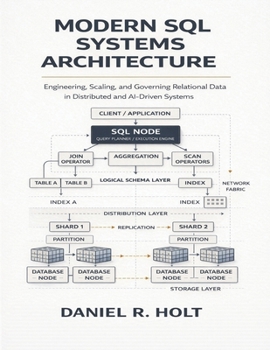
Modern SQL Systems Architecture: Engineering, Scaling, and Governing Relational Data in Distributed and AI-Driven Systems

By Daniel R. Holt
Relational databases remain the structural backbone of modern software systems. Yet at scale, SQL is no longer just a query language - it is infrastructure.
Modern SQL Systems Architecture is a definitive, architect-grade guide to designing, operating, and governing relational systems in distributed and AI-driven environments. Written for senior engineers, architects, and technical leaders, this book moves beyond syntax and tutorials to examine the mechanics that determine performance, correctness, resilience, and cost.
From concurrency control and replication realities to partitioning strategy, index architecture, cloud warehouse economics, and AI-generated workload governance, this book connects internal engine behavior to real-world operational consequences. Every chapter focuses on structural trade-offs, failure modeling, and long-term architectural sustainability.
What You Will ExploreCost-based optimization mechanics and plan instability under real workloadsMVCC, write-ahead logging, and the operational meaning of isolationPartitioning and sharding strategies that survive growthIndex design as a write-amplification decisionSchema evolution without downtimeCloud-native execution and consumption-based cost governanceSQL in machine learning pipelines and AI-generated workloadsGuardrails that prevent autonomous query cost explosionsBuild vs. buy decisions, vendor lock-in realities, and SLA trade-offsFailure case studies that expose hidden systemic riskWho This Book Is ForThis book is written for senior software engineers, database engineers, data platform architects, site reliability engineers, and CTO-level leaders responsible for production systems. It assumes familiarity with SQL fundamentals and focuses on systems mechanics, distributed behavior, and long-term architectural trade-offs.
If you are responsible for platform stability, replication reliability, performance engineering, cost governance, or data infrastructure strategy, this book is designed for you.
What This Book Is NotThis is not a beginner's guide to SQL. It does not teach basic syntax, introductory queries, or step-by-step tutorials. It is not a vendor-specific manual, certification prep guide, or collection of isolated tuning tricks.
Instead, it is a long-form systems reference built to strengthen architectural judgment and operational clarity in real production environments.
Relational engines endure because they encode discipline. This book helps you operate them with the same discipline.
Customer Reviews
ThriftBooks ® and the ThriftBooks ® logo are registered trademarks of Thrift Books Global, LLC
