


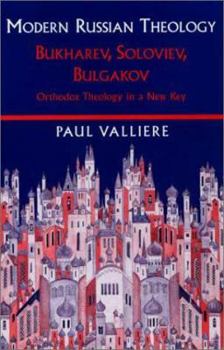
Modern Russian Theology: Bukharev, Soloviev, Bulgakov: Orthodox Theology in a New Key

The Russian school of modern Orthodox theology has made an immense but undervalued contribution to Christian thought. This groundbreaking study introduces the Russian school through the life and... This description may be from another edition of this product.
Format:Hardcover
Language:English
ISBN:0802839088
ISBN13:9780802839084
Release Date:January 2001
Publisher:Eerdmans Pub Co
Length:443 Pages
Weight:1.50 lbs.
Dimensions:8.8" x 1.8" x 5.5"
Customer Reviews
1 rating
Coming out of the winter...
Published by Thriftbooks.com User , 22 years ago
Paul Valliere states that the study of modern Russian theology through the works of Bukharev, Soloviev, and Bulgakov gives a representative view of early, middle and late periods. The Russian Orthodox theologians began the approach to modernity much earlier than others in the Orthodox world; as such, they were pioneers, without guides. Interrupted by the Soviet experiment, it has only been in the past few decades that the work of such theologians has again come to the forefront.Valliere states that Bukharev was Russian Orthodoxy's first modern theologian, but that he was building on the work of early philosophers and thinkers. It was Bukharev, however, who brought the problem of modernity into the church context - Bukharev's education was fairly typical of Russian Orthodox clerics, without great exposure to the body of ideas from Western sources as the other thinkers would undoubtedly have had. Also, Bukharev's thought was through Orthodoxy, not as a dispassionate and separate system, but as 'the' system. Soloviev represents a middle point, not merely on a chronological scale, but also because he is a mediator of sorts between Russian Orthodoxy and modern critical thought. Soloviev was not a student or disciple of Bukharev, yet there is a resonance at the core of their ideas, expressed in different ways, Soloviev's the more modern and sophisticated philosophically. Bulgakov, on the other hand, did have a direct association with Soloviev - they were not colleagues or collaborators, but rather Bulgakov belonged to the generation of thinkers inspired by Soloviev's ideas and methods. Bulgakov, raised in an Orthodox clerical family, threw off for a time this calling for more secular pursuits (he became a first-rate economist), until eventually accepting ordination in the fateful time at the end of the first world war, when the modern Russian Orthodox theological school was effectively at an end, or at least in a deep hibernation until the late twentieth century.This text is not a history, or a biography, or a literature survey, although it contains elements of each of these areas. What Valliere does is to trace out the development of theological content in the Russian Orthodox theological encounter with modernity, from its beginnings to the last days immediately prior to the Soviet revolution. In his final chapter, Valliere looks at the developments after Bulgakov, who had no direct heirs in the dogmatic theological task. Other Russian exiles and interested persons of the West helped to keep the memory of this school (and other Eastern European intellectual endeavours) alive; important persons such as Schmemann and Meyendorf (both of whom were teachers of this author, Paul Valliere) have brought Orthodoxy into the Western view; perhaps inevitably, the influences of the West were going to be felt and become shaping and interpreting forces on the theological school in exile, even as it returns to Mother Russia.There is an extensive bibliograp
Copyright © 2026 Thriftbooks.com Terms of Use
| Privacy Policy | Do Not
Sell/Share My Personal Information | Cookie Policy | Cookie Preferences | Accessibility Statement
ThriftBooks® and the ThriftBooks® logo are registered trademarks of Thrift Books Global, LLC
ThriftBooks® and the ThriftBooks® logo are registered trademarks of Thrift Books Global, LLC
