


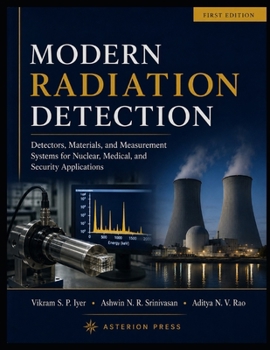
Modern Radiation Detection: Detectors, Materials, and Measurement Systems for Nuclear, Medical, and Security Applications
No Customer Reviews

The physics of radiation detection has barely changed in a generation - yet the instruments built on it have been transformed.
Silicon photomultipliers have displaced vacuum tubes, new scintillator crystals reach resolutions once out of reach, room-temperature semiconductor detectors are now routine, a global helium-3 shortage reshaped neutron detection, and signal processing has become almost entirely digital. Anyone who learned from older references faces a widening gap between the classic foundations and the equipment actually in use - with no single, rigorous, current account that connects the two.
This comprehensive guide closes that gap. It keeps the durable physics - energy loss in matter, the statistics of counting, and the operating principles of every major detector - and rebuilds the modern technology around it, developing each result from first principles and showing the full working of every derivation and worked example.
Inside, you will: Understand how gas-filled, scintillation, and semiconductor detectors work, from charge creation to final spectrumCompare detector families by energy resolution, efficiency, timing, and dead timeExplore modern photodetection, including silicon photomultipliers and imaging arraysSeparate neutrons from gamma rays and follow neutron detection beyond the helium-3 shortageWork through the digital signal chain, from preamplifiers and pulse shaping to data acquisitionReduce background with shielding and low-level counting, and connect each method to nuclear, medical-imaging, and security workKey topics include radiation sources and radiological units; the interaction of radiation with matter; counting statistics; ionization, proportional, and Geiger-M ller counters; scintillation materials and photodetectors; gamma-ray spectroscopy; silicon, germanium, and compound-semiconductor detectors; slow and fast neutron detection; digital pulse processing and data acquisition; background and shielding; and emerging detector technologies.
It is written for upper-level undergraduate and beginning graduate students, and for practicing engineers and scientists who need a current, rigorous, and dependable account of the instruments they rely on.
Open the book and begin building the clear, first-principles understanding of the detectors and measurement systems that define modern radiation detection - a guide to learn from now and keep within reach for years.
Silicon photomultipliers have displaced vacuum tubes, new scintillator crystals reach resolutions once out of reach, room-temperature semiconductor detectors are now routine, a global helium-3 shortage reshaped neutron detection, and signal processing has become almost entirely digital. Anyone who learned from older references faces a widening gap between the classic foundations and the equipment actually in use - with no single, rigorous, current account that connects the two.
This comprehensive guide closes that gap. It keeps the durable physics - energy loss in matter, the statistics of counting, and the operating principles of every major detector - and rebuilds the modern technology around it, developing each result from first principles and showing the full working of every derivation and worked example.
Inside, you will: Understand how gas-filled, scintillation, and semiconductor detectors work, from charge creation to final spectrumCompare detector families by energy resolution, efficiency, timing, and dead timeExplore modern photodetection, including silicon photomultipliers and imaging arraysSeparate neutrons from gamma rays and follow neutron detection beyond the helium-3 shortageWork through the digital signal chain, from preamplifiers and pulse shaping to data acquisitionReduce background with shielding and low-level counting, and connect each method to nuclear, medical-imaging, and security workKey topics include radiation sources and radiological units; the interaction of radiation with matter; counting statistics; ionization, proportional, and Geiger-M ller counters; scintillation materials and photodetectors; gamma-ray spectroscopy; silicon, germanium, and compound-semiconductor detectors; slow and fast neutron detection; digital pulse processing and data acquisition; background and shielding; and emerging detector technologies.
It is written for upper-level undergraduate and beginning graduate students, and for practicing engineers and scientists who need a current, rigorous, and dependable account of the instruments they rely on.
Open the book and begin building the clear, first-principles understanding of the detectors and measurement systems that define modern radiation detection - a guide to learn from now and keep within reach for years.
Format:Paperback
Language:English
ISBN:B0H9JLC9KY
ISBN13:9798188011895
Release Date:July 2026
Publisher:Independently Published
Length:540 Pages
Weight:2.72 lbs.
Dimensions:1.1" x 8.5" x 11.0"
Related Subjects
Engineering Science Science & Math Science & Scientists Science & Technology TechnologyCustomer Reviews
0 rating
Copyright © 2026 Thriftbooks.com
Terms of Use | Privacy Policy | Do Not Sell/Share My Personal Information | Cookie Notice | Cookie Preferences | Accessibility Statement
ThriftBooks ® and the ThriftBooks ® logo are registered trademarks of Thrift Books Global, LLC
ThriftBooks ® and the ThriftBooks ® logo are registered trademarks of Thrift Books Global, LLC
