


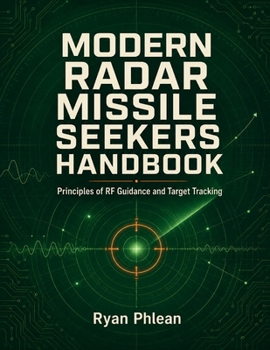
Modern Radar Missile Seekers Handbook

This handbook gives you a structured, technically grounded understanding of how these sophisticated RF guidance systems work.
Beginning with electromagnetic propagation, antenna fundamentals, the radar range equation, and target scattering, the book progressively connects radar theory to seeker architectures, tracking loops, guidance laws, electronic warfare, and system testing.
Inside, you will learn how to:
Understand pulsed, continuous-wave, and pulse-Doppler seeker operationApply detection theory, matched filtering, pulse compression, and Doppler processingCompare conical-scan, sequential-lobing, and monopulse angle trackingExplore active, semi-active, passive, and multimode seeker architecturesConnect line-of-sight measurements to proportional navigation and terminal guidanceExamine clutter, multipath, chaff, jamming, deception, and seeker counter-countermeasuresUnderstand phased arrays, cognitive radar, machine-learning applications, and emerging RF seeker technologiesFollow the complete seeker chain-from RF reception and target acquisition to track formation, guidance integration, and hardware-in-the-loop evaluationRather than concentrating on a specific fielded weapon, the handbook explains established, openly published principles at the physics, signal-processing, and control-system levels. Its logical progression makes complex relationships easier to follow for engineering students, aerospace professionals, radar specialists, defense analysts, and technically curious readers.
If you want one coherent resource that connects radar detection, target tracking, missile guidance, and electronic warfare, add Modern Radar Missile Seekers Handbook to your technical library today.Customer Reviews
ThriftBooks ® and the ThriftBooks ® logo are registered trademarks of Thrift Books Global, LLC
