


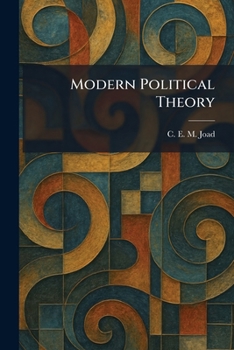
Modern Political Theory

Select Format
Select Condition 
Book Overview
"Modern Political Theory" is a profound and comprehensive examination of the various ideologies and systems of thought that defined the political landscape of the early 20th century. Written by C.E.M. Joad, this work provides a systematic overview of the most influential political movements of the era, including socialism, syndicalism, and guild socialism. The text expertly dissects the fundamental concepts of statehood, authority, and individual liberty, offering a critical assessment of how these competing ideas impact the structure and function of human society.
The work explores the inherent tensions between collectivism and individualism, evaluating the merits and pitfalls of different models of social and economic organization. By analyzing the philosophical roots of modern governance, Joad provides readers with a robust framework for understanding the complexities of political authority and the evolving role of the state in human affairs. This book remains an invaluable resource for scholars of political science and history, serving as a significant contribution to the study of ideological development and the ongoing quest for an effective and just social order.
This work has been selected by scholars as being culturally important, and is part of the knowledge base of civilization as we know it. This work was reproduced from the original artifact, and remains as true to the original work as possible. Therefore, you may see the original copyright references, library stamps (as most of these works have been housed in our most important libraries around the world), and other notations in the work.
This work is in the public domain in the United States of America, and possibly other nations. Within the United States, you may freely copy and distribute this work, as no entity (individual or corporate) has a copyright on the body of the work.
As a reproduction of a historical artifact, this work may contain missing or blurred pages, poor pictures, errant marks, etc. Scholars believe, and we concur, that this work is important enough to be preserved, reproduced, and made generally available to the public. We appreciate your support of the preservation process, and thank you for being an important part of keeping this knowledge alive and relevant.
Customer Reviews
ThriftBooks ® and the ThriftBooks ® logo are registered trademarks of Thrift Books Global, LLC
