


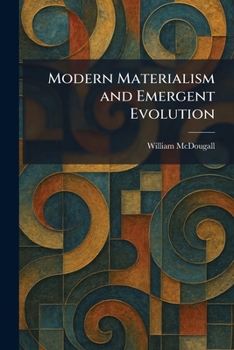
Modern Materialism and Emergent Evolution

Select Format
Select Condition 
Book Overview
"Modern Materialism and Emergent Evolution" is a profound philosophical inquiry into the nature of existence and the limitations of physicalist science. Written by the renowned psychologist and philosopher William McDougall, the work addresses the critical tension between mechanistic materialism and the theory of emergent evolution. McDougall challenges the reductionist view that life and consciousness are merely the sum of physical and chemical components, arguing instead that evolution produces novel properties and functions that cannot be fully explained by their constituent parts alone.
Throughout the text, McDougall examines the implications of evolutionary theory for our understanding of the human mind and soul. He critiques the rigid scientific dogmas of his time and advocates for a broader perspective that acknowledges the purposive and teleological aspects of life. By bridging the gap between biology and philosophy, McDougall provides a compelling defense of the idea that mind is an active, creative force in the universe. This work remains an essential study for those interested in the philosophy of science, evolutionary biology, and the historical development of psychological theory. It offers a sophisticated critique of scientific materialism that continues to resonate in contemporary debates about the origin of consciousness.
This work has been selected by scholars as being culturally important, and is part of the knowledge base of civilization as we know it. This work was reproduced from the original artifact, and remains as true to the original work as possible. Therefore, you may see the original copyright references, library stamps (as most of these works have been housed in our most important libraries around the world), and other notations in the work.
This work is in the public domain in the United States of America, and possibly other nations. Within the United States, you may freely copy and distribute this work, as no entity (individual or corporate) has a copyright on the body of the work.
As a reproduction of a historical artifact, this work may contain missing or blurred pages, poor pictures, errant marks, etc. Scholars believe, and we concur, that this work is important enough to be preserved, reproduced, and made generally available to the public. We appreciate your support of the preservation process, and thank you for being an important part of keeping this knowledge alive and relevant.
Customer Reviews
ThriftBooks ® and the ThriftBooks ® logo are registered trademarks of Thrift Books Global, LLC
