


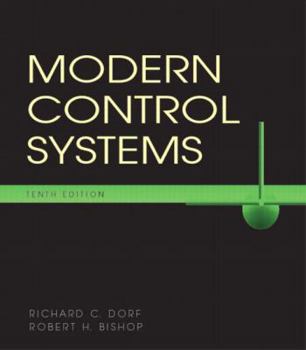
Modern Control Systems


Select Format
Select Condition 
Book Overview
KEY BENEFIT The purpose of Dorf's Modern Control Systems, Thirteenth Edition is to present the structure of feedback control theory and to provide a sequence of exciting discoveries. The book... This description may be from another edition of this product.
Format:Hardcover
Language:English
ISBN:0131457330
ISBN13:9780131457331
Release Date:January 2004
Publisher:Prentice Hall
Length:881 Pages
Weight:3.54 lbs.
Dimensions:9.8" x 1.3" x 8.0"
Customer Reviews
2 ratings
the Classical Control Systems Engineering approach
Published by BookNerd , 5 months ago
As a former educator, I would put the level of Dorf's texts at the junior to 1st year graduate level. I purchased the rarer 2nd edition. This is that classical textbook approach of the 1960's -70's where the writing is short and brief but to the point, if you can catch it; and that's exactly what that writing style is about.The problems and exercises are pretty much the same without answers to all of them. That was the point of teaching then; to make you think and learn how to think beyond what was presented on fewer pages than what is more typical now. If you like a challenge and thinking while reading to learn then this text may fit your need. This edition seems to be rarer to find. Get one for your bookshelf while the opportunity exists.
Modern Control Systems Using Classical Methods
Published by Thriftbooks.com User , 22 years ago
I am a practicing systems engineer in industry. My company, Transpower Corporation, writes custom and commercial engineering and accounting software. Over the years I've purchased many, many control engineering books, including the fourth and seventh editions of Prof. Dorf's Modern Control Systems. At my request, Dr. Dorf sent me the solutions manual. Unlike the other reviewers here, I find the book to be easy reading, particularly because of the many fine illustrations which add immensely to the clarity of presentation. The 800 problems contained in the book cover a very wide range of modern real-life control systems; they are vastly better than the problems contained in any other control book I've purchased.The book is very strong on classical methods, but rather weak on the so-called "modern methods." I happen to prefer the Internal Model Principle and even wrote a software package, Optimal Control Designer, to make that method easy to apply. Unfortunately Dorf treats the Internal Model Principle only briefly. The same goes for LQR and other optimization methods. On the other hand, ITAE and deadbeat systems are treated rather well.The use of MATLAB in the book and problems is very welcome. However, Simulink is not used. Those of us in industry are likely to use Simulink to simulate a proposed system to death before production. Hopefully the forthcoming 10th edition will include example applications using Simulink.One other deficiency is the lack of treatment of real-time computer control (for example using Real-Time Workshop and Real-Time Windows Target). I haven't yet found any text on control which goes into any detail on this subject--those of us in industry would very much like such a text.In summary I highly recommend this book. It's worth the price just for the spectacular set of end-of-chapter problems.
Copyright © 2026 Thriftbooks.com
Terms of Use | Privacy Policy | Do Not Sell/Share My Personal Information | Cookie Notice | Cookie Preferences | Accessibility Statement
ThriftBooks ® and the ThriftBooks ® logo are registered trademarks of Thrift Books Global, LLC
ThriftBooks ® and the ThriftBooks ® logo are registered trademarks of Thrift Books Global, LLC
